

Using the Harmony Triads and the Enneagram’s Comprehensive System to Build Developmental Pathways–From 1 (Wholeness) to 3 to 9 to 27 Patterns
Published: March 3, 2026 (Updated: October 24, 2026)
Abstract: This article has three aims: (1) to examine David Daniels’ contemporary contribution to the triadic structure of the Enneagram Harmony Triads which align with Gurdjieff and Ichazo scholarship, (2) to situate the Harmony Triads within the broader comprehensive Enneagram of Personality System in which the Centers, behavioral orientation, emotional regulation, energy regulation, and the instincts interact, and (3) to compare the triadic structure of the Harmony Triads with the PDP Attendency hypothesis, particularly in relation to Patterns 5 and 7. The proposed pathway from wholeness (one) to three Centers to nine personality patterns to 27 instinctual subtypes describes a developmental differentiation within the Enneagram patterns, while the comprehensive system describes the interacting functional domains through which the nine patterns are regulated and manifested as behavior.
Since first studying the Enneagram in 1984, I have sought to understand how the nine Enneagram personality patterns develop. This interest led to the formation of the PDP Group in 2003, which explored how traditional Enneagram teachings and patterns might be translated to contemporary child development, temperament, and attachment research. In 2025, I revisited work my father, David Daniels, conducted between 2008 and 2012 on what he labeled the Enneagram Harmony Triads. Additionally, I returned to source knowledge communicated by Gurdjieff and Ichazo.
Since first studying the Enneagram in 1984, I have sought to understand how the nine Enneagram personality patterns develop. This interest led to the formation of the PDP Group in 2003, which explored how traditional Enneagram teachings and patterns might be translated to contemporary child development, temperament and attachment research. In 2025, I revisited work my father, David Daniels, conducted between 2008 and 2012 on what he labeled the Enneagram Harmony Triads. Additionally, I returned to source knowledge communicated by Gurdjieff and Ichazo.
David Daniels’ contribution to the Enneagram Harmony Triads invites a closer examination of the Enneagram’s underlying triadic organization. Within the Enneagram system, the Harmony Triads describe three adaptive behavioral orientations or “actions” (Outward–ACT FOR 8-2-5, Inward–ACT ON 1-4-7, and Dyadic–ACT WITH 9-3-6). These orientations bring value to others and help the child move toward wholeness, by narrowing the gap between internal states and what the environment offers or demands. When the environment consistently rewards these adaptive behaviors, they become increasingly reinforced over time.
The organization of personality reveals a recurring triadic structure that extends beyond behavioral orientation to three additional domains of psychological functioning: (1) Center of Intelligence Triads (Body–Agency, Heart–Bonding, Head–Certainty), (2) Emotional Regulation Triads (Shift, Contain, Express), and (3) Energy Regulation Triads (Receptive–In and Down, Active–Up and Out, Balancing–Dyadic). Within each domain, every Enneagram pattern exhibits a predominant orientation that is directed outward to the external environment, inward to internal state, or organized around attempting to reconcile internal state with the external environment. Rather than representing independent traits, these dimensions unfold as different expressions of a common underlying threefold recurring pattern. This triadic pattern creates and operates in the whole Enneagram of Personality System in parallel and interactive pathways.
This triadic structure yields slightly different results from the PDP (Patterns of Developmental Pathways) framework, particularly in its treatment of Patterns 5 and 7.
Side Note
To date, this is the only article on the drdaviddaniels.com website written by his daughter, Denise Daniels. All other content has been written by David Daniels. For further information see:
Introduction
Importance of Developmental Pathways
Understanding the developmental pathways of our personality helps us understand why we are who we are and why others are the way they are. This understanding fosters a nonjudgmental acceptance of ourselves and others which can shift our lives in profound ways (Daniels and Dion, 2025).
By viewing personality as a developmental process of awareness rather than as a fixed identity, we can recognize how our personality runs on autopilot and seek to develop beyond its limitations (Ouspensky, 1950; Nicoll, 1952–1956).
David Daniels’ Contribution to the Harmony Triads
David Daniels’ work on the Harmony Triads (see Daniels, 2012 Harmony Triads) provides an important key to understanding these developmental pathways. His work brings a small but significant contribution to knowledge dating back thousands of years (Gurdjieff, 1950, 1963, 1981; Ichazo, 1973/1982b). Drawing on more than 40 years of clinical observation, experience, and teaching, Daniels recognized that each pattern had a head, heart, and body connection that the traditional hexad lines of the Enneagram do not provide – a heart-head between Pattern 2 and 5 as well as 7 and 4. He subsequently used these connecting lines, which form three equilateral triangles, in his clinical and teaching work as a framework for promoting psychological integration.
Daniels recognized that each pattern had a head, heart, and body connection not represented by the Enneagram’s traditional hexad lines: a heart–head connection between Patterns 2 and 5, as well as between Patterns 4 and 7. He subsequently applied these connecting lines in his clinical and teaching work, as a framework for promoting psychological integration.
The important and contemporary contribution of Daniels’ work is his distinction between descriptions of personality that emphasize conditioned, defensive, and contracted patterns and descriptions that emphasize healthier, undefended, and more integrated expressions of the same underlying orientation. This perspective shifts attention from personality as a description of outside characteristics and traits that run without our awareness to an inner dynamic developmental process toward higher states of consciousness: from passive “mechanical-attention” to active “drawn-attention” or mindfulness consciousness to eventually very active “controlled-attention” or sustained presence at all times, everywhere.
Although David Daniels, M.D. (2012) made a contemporary contribution to linking all triads, the three Centers, and the healthy and less healthy labels of regulation in the microcosm of the Harmony Triads, the fundamental path that makes up the whole of the harmony has best been described by Oscar Ichazo, circa 1966 to1970 (Sam Keen in Psychology Today, 1973/Ichazo, 1982b; Lilly and Hart, 1970/1975; Ichazo, 2024a).
This article provides a recapitulation of David Daniels’ contribution to the Harmony Triads, aligning with teachings and scholarship of G.I. Gurdjieff and Oscar Ichazo who played important roles in bringing and developing Enneagram knowledge in the West during the 20th Century. For Gurdjieff scholarship, see P.D. Ouspensky’s works (1949, 1950, and 1971) and the five-volume psychological commentaries by Dr. Maurice Nicoll (1952-56); for scholarship on Ichazo’s work, see his 2024 publications.
Background to the Triadic Recurring Pattern of the Enneagram Harmony Triads
Over the past several decades, the Enneagram has attracted great interest among practitioners, educators, coaches, and researchers seeking to understand personality and human development. Academic interest in and empirical study of the patterns embedded in the Enneagram have increased internationally, including research on measurement and applications in counseling, education, organizational development, and self-development. A search on Google Scholar for the keyword “Enneagram” provides a glimpse of this growing interest, which extends beyond books and dissertations to academic journal articles around the world.
This article examines developmental pathways in light of the simple threefold pattern found in the Enneagram Harmony Triads. Beginning with the three Centers of Intelligence, the same outward, inward, and dyadic pattern recurs in the Harmony Triads, the Emotional Regulation Triads, the Energy Regulation Triads, and the organization of the nine personality patterns (Stenstrom, 2010). The triadic recurring organization resembles what mathematicians view as analogous to recursive or self-similar structure, consistently demonstrated across all classes and levels of the system.
Developmental Pathways of the Enneagram System
In the Enneagram system brought forward by Gurdjieff and Ichazo, human development is often described as beginning in utero with an original experience of undifferentiated connection or wholeness, followed after birth by an increasing awareness of self and others during infancy and early childhood (Almaas, 2000; Ichazo, 1982b; Nicoll, 1952, Vol. 1). From our contemporary field of child development, development is described as a gradual differentiation between internal experience and the external environment, with children developing increasingly sophisticated ways of regulating their emotions, energy, behavior, and relationships.
Within the Eastern (Middle and Far) psychological traditions, human suffering is understood as arising from the “gap” between our internal states and what the environment provides or demands. A young child seeks love and acceptance, yet may experience the environment as unloving and judgmental (Lilly and Hart, 1975; Ichazo 1982b). Within this framework, the personality pattern develops as an adaptive coping mechanism to the experience of separation and perceived discrepancies between internal needs and the external environment.
The framework proposes a nested differentiation from experienced wholeness, to three Centers, to nine patterns, and then to 27 instinctual expressions. This is not intended as a series of four discrete chronological stages. The functional domains may operate independently or interactively, simultaneously or sequentially, and differently across contexts.
In sum, the pathway from one to three to nine to 27 describes a developmental differentiation of the Enneagram patterns, and the comprehensive system describes the interacting functional domains through which those patterns are regulated and manifested as behavior.
Importance of Labels in the Enneagram
Because various schools of psychology have studied the Enneagram since Oscar Ichazo introduced it in 1970 (Ichazo, 1993) to a group of psychiatrists, psychologists, and spiritual seekers from North America, various labels have been assigned to the triads which has caused a tremendous amount of confusion in understanding. Thus, for each of the four triads a detailed table is presented to show how various labels describe the same function.
In the following four sections, the triads are explained in this order, each with a table of labels:
- The Center of Intelligence Triads
- The Harmony Triads
- The Emotional Regulation Triads
- The Energy Regulation Triads
The Centers of Intelligence Triads: Evolution of the Three Centers of Intelligence Optimizing Three Survival Instincts
In the Enneagram tradition brought forward by Gurdjieff and Ichazo, the three Centers of Intelligence are considered to be three broad functional systems associated with optimizing three survival instincts (Ouspensky, 1949; Ichazo, 2024a, 2024b). Rather than representing separate parts of the mind, the Centers operate simultaneously as “mind” viewed as complementary modes of processing information and regulating behavior. The soma senses, emotions react, and cognition assesses.
In addition to the natural species instincts communicated by Gurdjieff and Ichazo, psychiatrist Claudio Naranjo described these three survival instincts using terminology to describe the conditioned personality and how the instincts operate in psychopathology (Naranjo, 1990) as shown in Table 1a.
Table 1a: Comparative Labels for the Three Survival Instincts
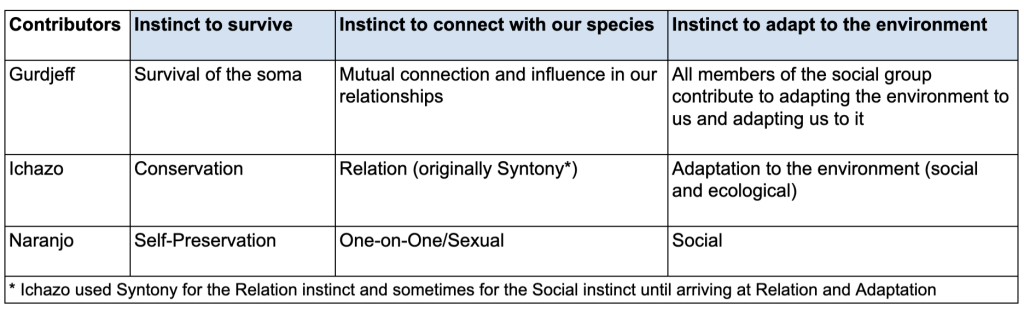 Within the Enneagram tradition, the three Centers of Intelligence are understood as broad functional systems associated with three survival instincts: Conservation, Relation, and Adaptation. Each Center is proposed to organize characteristic patterns of motivation, attention, information processing, memory, emotional regulation, energy regulation, and behavior. Table 1b summarizes these key functions. Specifically, the key functions of each Center are related to organisms with nervous systems and the capacity for associative learning.
Table 1b: Triadic Patterns of the Centers for Key Functions
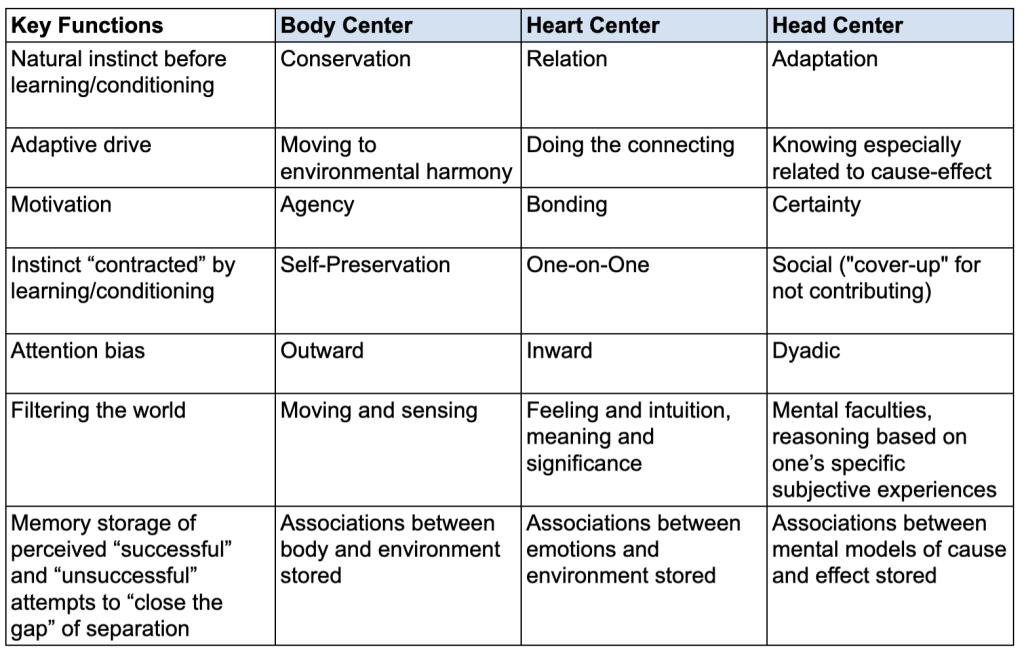
As seen in Table 1b, the Enneagram distinguishes three broad natural survival instincts—Conservation, Relation, and Adaptation, which operate for survival of the species. However, the conditioned personality contracts or distorts the instincts which then operate for self and the important people in one’s life, conventionally labeled Self-Preservation, One-to-One, and Social.
Body (Instinctual-Moving) Center – Optimizing the Conservation Survival of the Soma Instinct
The Body Center serves the survival instinct more than the other two Centers. And that survival instinct manifests mainly as conservation–having everything needful and satisfying to the operation of continuing existence. In the Enneagram tradition its adaptive drive is toward harmony with the environment–maintaining an optimal relationship between the organism and its surroundings through effective movement to environments with optimized resources and minimized threat.
The Body Center is associated primarily with empowerment, justice, and other conservation-related behaviors. Its attention is directed outward to the environment in order to assure (and even defend) what it sees as needful. The Body Center filters the world through a more kinesthetic or moving-boundary intelligence, including taking in impressions from the senses, physical sensations of movement in the world, and gut instincts. It then stores in memory the ways that body-based sensory filtering unsuccessfully and successfully closes “gaps” between internal state and perception of the environment.
In a healthy state it draws the emotions into play; in a contracted state it defends itself with anger and aggression.
With its primary emphasis on bodily self-preservation, the Body Center’s key function is receiving the external environment through the senses and movement. The article sections to follow will describe how the Body Center has a bias in outward orientation to act:
- Attention primarily directed outward to the environment, building confidence to act by understanding the environment
- Emotional regulation that pauses action, turning outward to assess or reframe the environment, then inward to shifting emotional state for positive action serving self and others
- Energy regulation that protects self – energy flows from outward to inward, receiving the environment through the senses and movement, and directing energy in and down to protect self
Heart (Emotional-Relational) Center – Optimizing the Relation One-on-One Instinct
The Heart Center serves the relational instinct more than the other two Centers–having to create relationships for mating, pair-bonding, care of young, and other important relationships. In the Enneagram tradition, its adaptive drive is toward doing the connecting–actively asserting self in response to internal feeling states. Both positive and aversive emotions prompt rapid action.
The Heart Center is associated primarily with mating, pair-bonding, and mother-infant bonding, but must also forge relationships with important and protective figures for individual survival. Its attention is primarily inwards, looking for what might be either disruptive to well-being or better for it than what the current environment provides. The Heart Center filters the world through intuition, relational intelligence, and emotions. It then stores in memory the ways that heart-based intuitive filtering unsuccessfully and successfully closes “gaps” of separation between internal states and perception of the environment.
In a healthy state it promotes bonding and care; in a contracted state it defends itself with deceit and “display” or image (to gain approval), or contracts to separation-distress, sadness, and shame.
With its primary emphasis on connecting with one’s species, the Heart Center’s key function is to assert self through emotions critical in competition for mating and to establish relationships that support individual development and continuation of the species. The article sections to follow will describe how the Heart Center has a bias in inward orientation to act:
- Attention primarily directed inward to internal emotional states, building confidence by relying on inner abilities to know what to do
- Emotional regulation through inward containing in a “wait” with attention focused on inner rationale and logic before outward asserting of solutions that work for self and others
- Energy regulation that protects self – energy flows from inward to outward, being “first” to assert a position, active asserting of self through inner emotional state, energy flowing up and out toward result to protect self
Head (Cognitive - Intellectual) Center – Optimizing the Adaptation Social Instinct
The Head Center serves the adaptation instinct more than the other two Centers–having the knowledge of how to close the “gaps” between desired and current environment. In the Enneagram tradition, its adaptive drive is toward knowing–developing understanding of cause and effect and reconciliation between the memory of internal experience and perceived external observations. Discerning root-cause takes time and gives rise to continually relating internal solutions and plans to external events in order to increase certainty, predictability, and master the environment through building solutions and tools to make the environment more amenable.
The Head Center is associated primarily with adaptation within larger social and ecological systems. Its attention is dyadic in nature: looking outwards for opportunity and inwards for solution, but it can get “stuck” and oscillate if there’s a looming need or threat for which it has no “cause-effect” solution. The Head Center filters the world through mental faculties and forming associations between cause and effect. It then stores in memory the ways that head-based cause-effect filtering unsuccessfully and successfully closes “gaps” between internal state and perception of the environment.
In a healthy state it seeks and explores new possibilities and experiences in the environment and social group; in a contracted state it avoids the unknown and collapses into fear, non-action, and failure to contribute to the social group.
With its primary emphasis on adaptation and “mastery” of the environment, its primary function is to reconcile internal state with the environment or a more sophisticated cause-effect discernment. The triad sections to follow will describe how the Head Center has a bias in dyadic orientation to act:
- Attention organized dyadically, continually relating internal experience and problem solving to environmental events, building confidence through knowledge and understanding
- Emotional regulation through expressing and evaluating both emotional information and outer environment as a dyadic discernment of whether the root cause is internal/self or external/other intending to serve self and other
- Energy regulation that protects self by dyadically attempting to balance self with others and the environment, the tension of energy in balancing results in protection of self through complying or compromising with others
Triadic Structure of the Centers of Intelligence Triads
Because the three Centers of Intelligence are associated with evolutionary functions (Ouspensky, 1949; Smith, 1993) tied to each of the three instincts, the Body Center recurring pattern places confidence in the outer environment, the Heart Center places it in the internal feeling state, and the Head Center attempts to reconcile outer and inner. Figure 1 shows the placement of the three Centers in the Enneagram diagram.
Figure 1. The Centers of Intelligence Triads
- Body – Outward biased attention to Harmony of Environment
- Heart – Inward biased attention to Internal Feeling State
- Head – Dyadic biased attention to Attempt to Reconcile Environment and Internal State
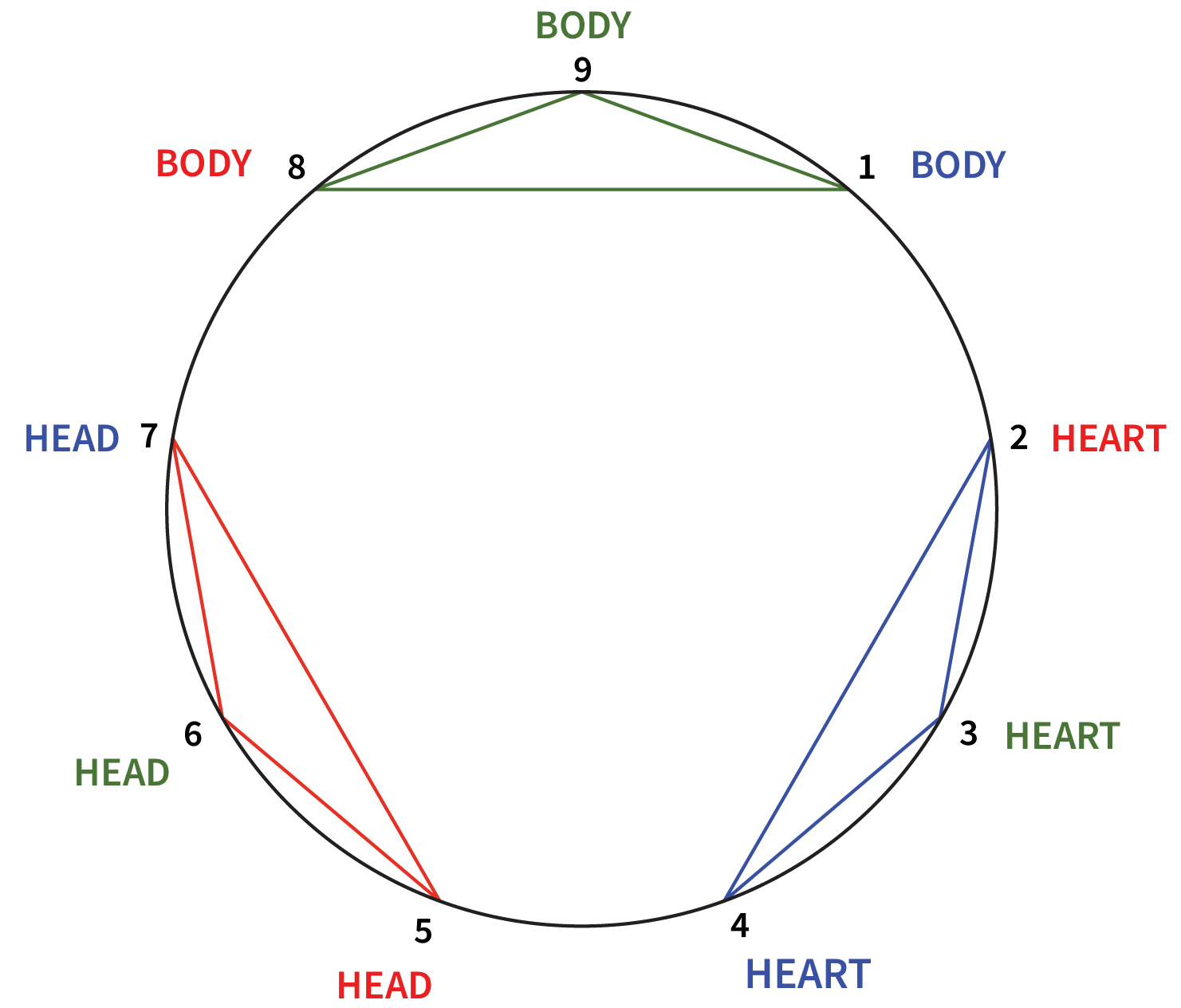
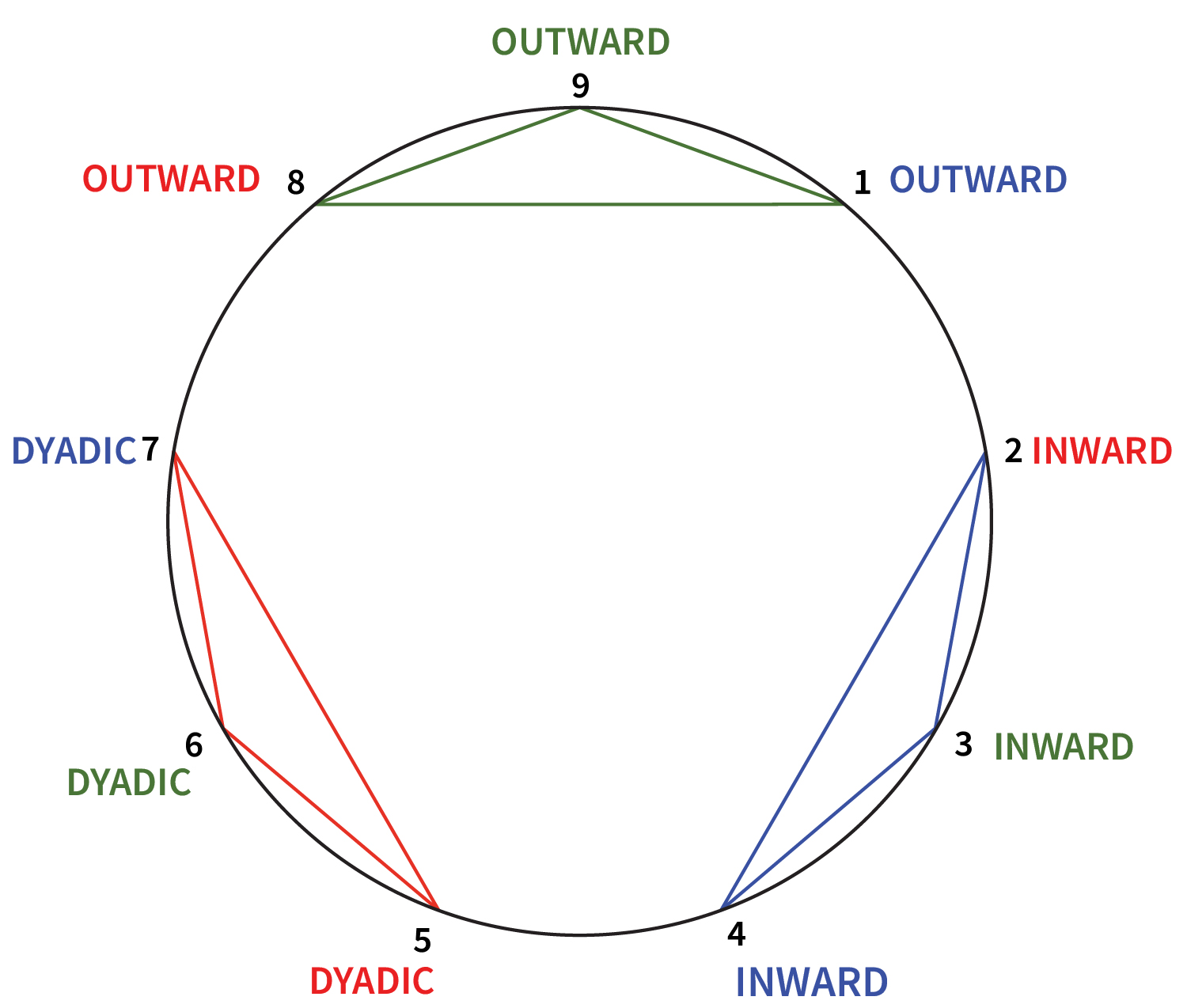
Early Naranjo teachings placed all three instincts in the Body Center. However, Gurdjieff and Ichazo scholarship place all three instincts in all Centers (Ouspensky, 1949; Ichazo, 2024b). However, the Self-Preservation instinct with soma-protection concerns become dominant in the Body Center, the One-on-One instinct with bonding concerns become dominant in the Heart Center, and the Social instinct with group adaptation concerns become dominant in the Head Center due to the proposed evolutionary purpose. At puberty all three instincts are impacted by human sexuality (the mammalian positive emotion of lust), particularly the One-on-One instinct, often called the Sexual Instinct.
Labels Describing the Centers of Intelligence Triads
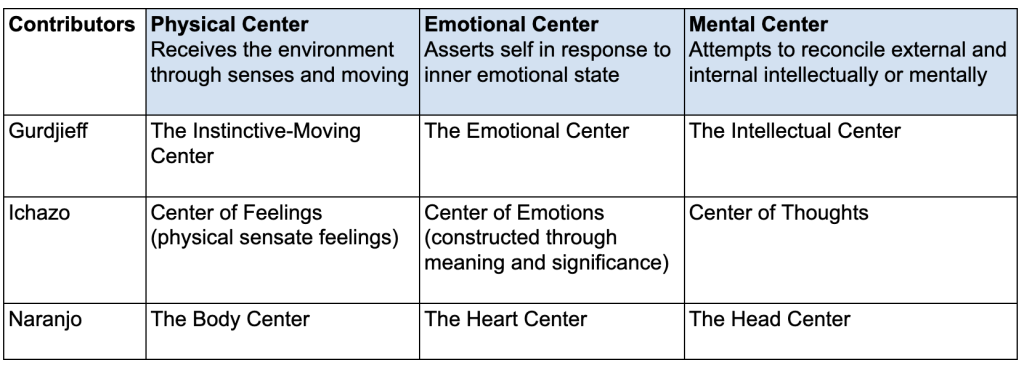
Gurdjieff, Ichazo, and Naranjo each used slightly different labels for the three Centers of Intelligence as summarized in Table 2a.
Table 2a: Center of Intelligence Triads: Various Labels Yet Same Core Purpose -- Optimizing the Survival Instincts
The Enneagram Harmony Triads: Act For, Act On, Act With
The Role of the Harmony Triads – Provides Reciprocal Value to Self and Others
Within each Center of Intelligence, adaptive behavior differentiates further into reciprocal value for self and others, described by Daniels as:
Outward ACT FOR (8-2-5): David Daniels described this triad as the Relationists, emphasizing the value each type contributes through outward engagement with the world.
Inward ACT ON (1-4-7): David Daniels described this triad as the Idealists, emphasizing their tendency to transform existing reality in accordance with internal standards and ideals.
Dyadic ACT WITH (9-3-6): David Daniels described this triad as the Pragmatists, emphasizing their continual balancing of what others need and what I can bring them through reciprocal engagement.
These outward, inward, and dyadic directions represent three distinct ways of organizing behavior that benefit the child’s attempts for restored wholeness, while also bringing value to others and the environment a child is raised in (Ichazo 2024a, 2024b, Wheeler, 2026). Together, they form the Harmony Triads and provide the developmental bridge from the three Centers of Intelligence to the nine Enneagram personality patterns.
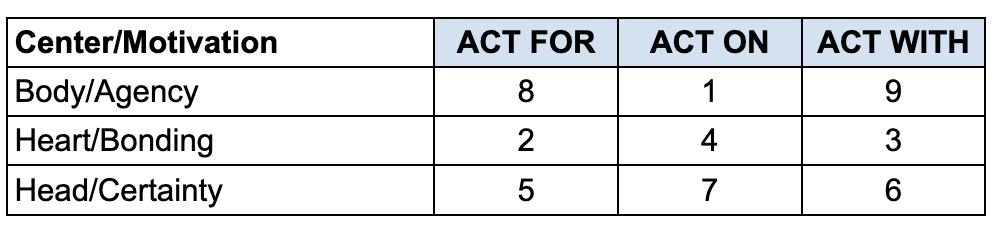
Table 2b captures the Enneagram’s central developmental path from three Centers to nine behavioral orientations as articulated by Ichazo (2024a). Each of the three Center-based motivations can be expressed through each of three behavioral orientations, yielding nine Center-Orientation combinations.
Table 2b: Bridging the Three Centers of Intelligence to the Nine Patterns Using the Harmony Triads
The Harmony Triads serve as a form of Behavioral Regulation: Is my behavior working for others? Is it working for self? Does it help close the gap between self and environment as I attempt to experience wholeness and assuage aversive emotions?
In the BODY CENTER
- We can ACT FOR the world — Protect others from harm and injustices while shielding self from vulnerability (Pattern 8)
- We can ACT ON the world — Make self the one with idealized harmony and share this perfection with others simultaneously achieving internal goodness for self (Pattern 1)
- We can ACT WITH the world — Minimize self and blend with others to prevent conflict and preserve a peaceful environment and harmony for self (Pattern 9)
In the HEART CENTER
- We can ACT FOR the world — Meet needs or make connections for others while also gaining approval for self by helping others (Pattern 2)
- We can ACT ON the world — Make self the one who connects our shared existential concerns and share them with others simultaneously gaining a deep sense of connection for self (Pattern 4)
- We can ACT WITH the world — Identify with doing and the internal value I bring and stay connected to make sure others approve of self by what I do (Pattern 3)
In the HEAD CENTER
- We can ACT FOR the world — Help others to solve their problems while creating models of understanding the world for my own self-knowledge (Pattern 5)
- We can ACT ON the world — Make self the one with a future ideal of wisdom and share it with others while simultaneously providing self with positive options for the future (Pattern 7)
- We can ACT WITH the world — Question the nature of reality for self and others while reducing doubt and building predictability for self (Pattern 6)
Triadic Structure of the Harmony Triads
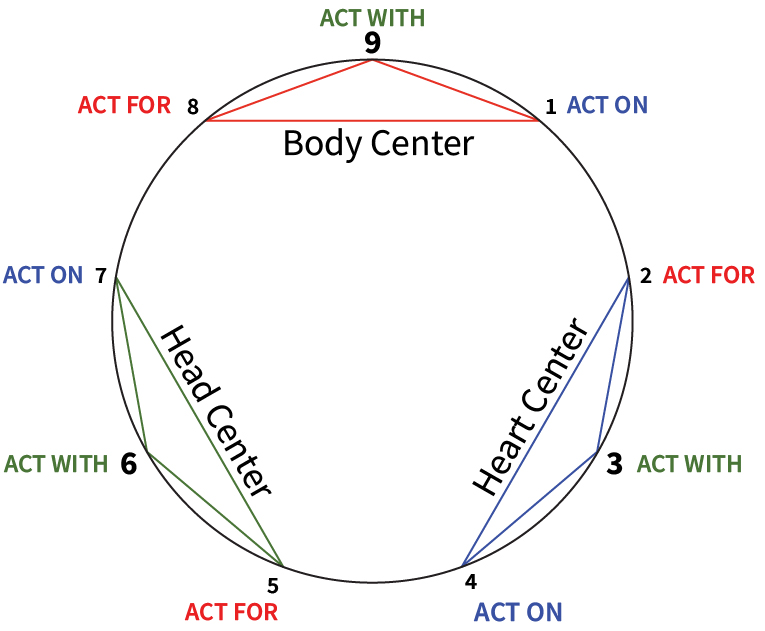
The three behavioral orientations of the Harmony Triads continue the pattern of outward, inwardly referenced, and dyadic modes of regulating and organizing behavior based on the proper evolutionary function of the Centers (see Figure 2 and 3).
Starting with Figure 2 each point within the triangles of each Center represents one of the nine Enneagram personality patterns expressing the motivational drive (harmony, doing the connecting, knowledge) in a distinct way. Each Center has a pattern that will ACT FOR, ACT ON, and ACT WITH.
Figure 2: The Three Centers Divide Into ACT FOR, ACT ON, and ACT WITH
- ACT FOR – Outward Organization of Behavior
- ACT ON – Inward Organization of Behavior
- ACT WITH – Dyadic Organization of Behavior
Next is Figure 3, Daniels' basic Harmony Triads diagram in which the structure conveys three properties.
Figure 3: The Harmony Triads, David Daniels, M.D. (2012)
- Center Triads: Body, Heart, Head
- Emotional Regulation Triads: Shift, Contain, Express (also called Positive Outlook, Competency, and Reactive)
- Energy Regulation Triads: Receptive (in and down), Active (up and out), Balancing (tension between) (also called Withdrawing, Asserting, Complying)
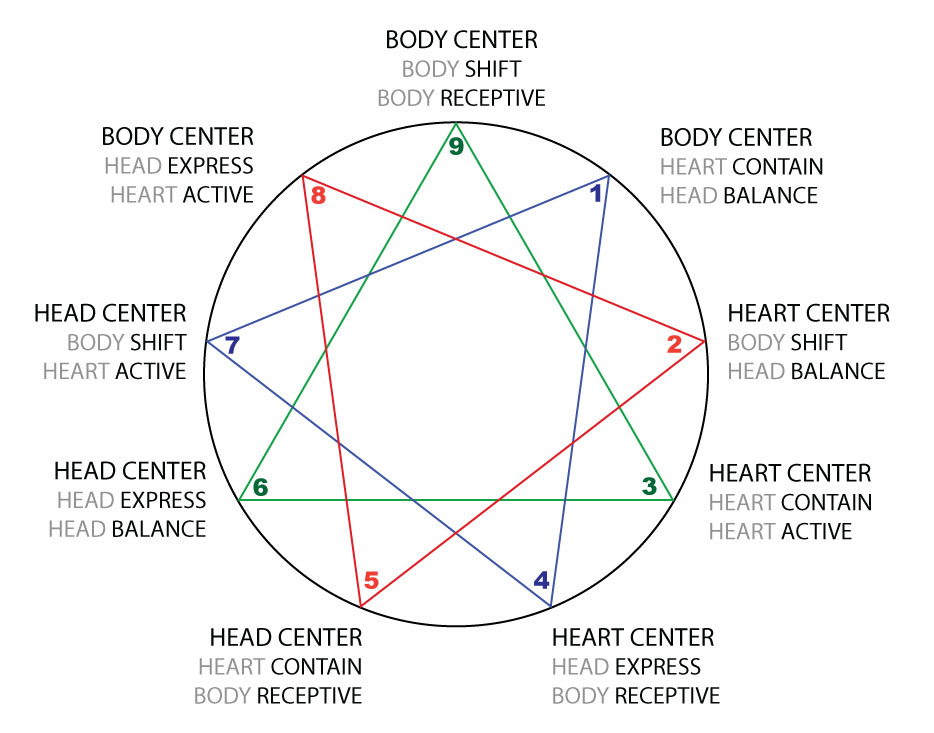
First, the three equilateral triangles represent the three basic actions of reciprocal value: Outward-ACT FOR (RED triangle), Inward-ACT ON (BLUE triangle), and Dyadic Attempt to Balance Inward and Outward ACT WITH (GREEN triangle) in which each triangle contains a Body, Heart, and Head Center.
Second, the words for the core points of 9, 3, 6 representing the three Centers suggest a steady use of their Center of Intelligence. However, it may look like their Center is underused because the Act With behavior blends, defers, and compromises. On the other hand, the wing points (1, 2, 4, 5, 7, 8) suggest a use of regulation modes of varying Centers (Daniels, 2012; Riso & Hudson, 2000).
Third, each of the three triads being expressed in the Harmony Triads also has a specific underlying purpose in which the instinct affirms, attempts to reconcile, or is denying. For each point, the Center (top position) is the primary first impulse instinct or affirming. Emotional Regulation (middle position) is the supporting instinct or reconciling. Energy Regulation (bottom position) is the passive instinct or denying.
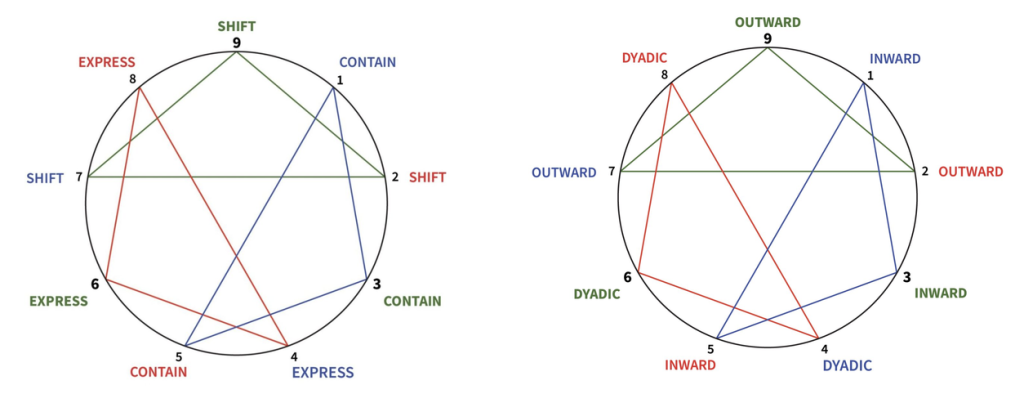
Consistent with the recurring triadic structure, the outward, inwardly referenced, and dyadic orientations are also expressed in the Emotional Regulation Triads (Outward-Shift, Inward-Contain, and Dyadic-Express), and the Energy Regulation Triads (Outward-Receptive flows to In and Down, Inward-Active flows to Up and Out, and Dyadic-Balancing) which will be described in upcoming sections of this article.
Many Labels Describing the Harmony Triads
In 1970, Ichazo communicated that there is an inward or internalized version and an outward or externalized version of core balancing points 9 (body), 3 (heart), and 6 (head). Ichazo’s 2024 publications present labels of Action (8, 2, 5), Reaction (1, 4, 7), and Result (9, 3, 6). Ichazo’s work indicates that we behave based on where we find “confidence to act” – confidence based on what the environment informs, confidence in our inner abilities to know what to do, or in a result that brings both together.
- Confidence to Act: From Environment | From Self | From Both
- Orientation: Outward | Inward | Dyadic
- Ichazo: Action | Reaction | Result
- Daniels: Relationists | Idealists | Pragmatists
- Wheeler/This article : ACT FOR | ACT ON | ACT WITH
Over the almost 60 years since Oscar Ichazo introduced the Enneagram to the “West,” numerous labels and descriptions have defined the core action or behavior that creates a pathway from relying on one of three Centers of Intelligence to nine personality types or patterns (see Table 3).
Table 3: The Harmony Triads: Many Labels Yet Same Core Purpose -- Provides Reciprocal Value to Self and Others
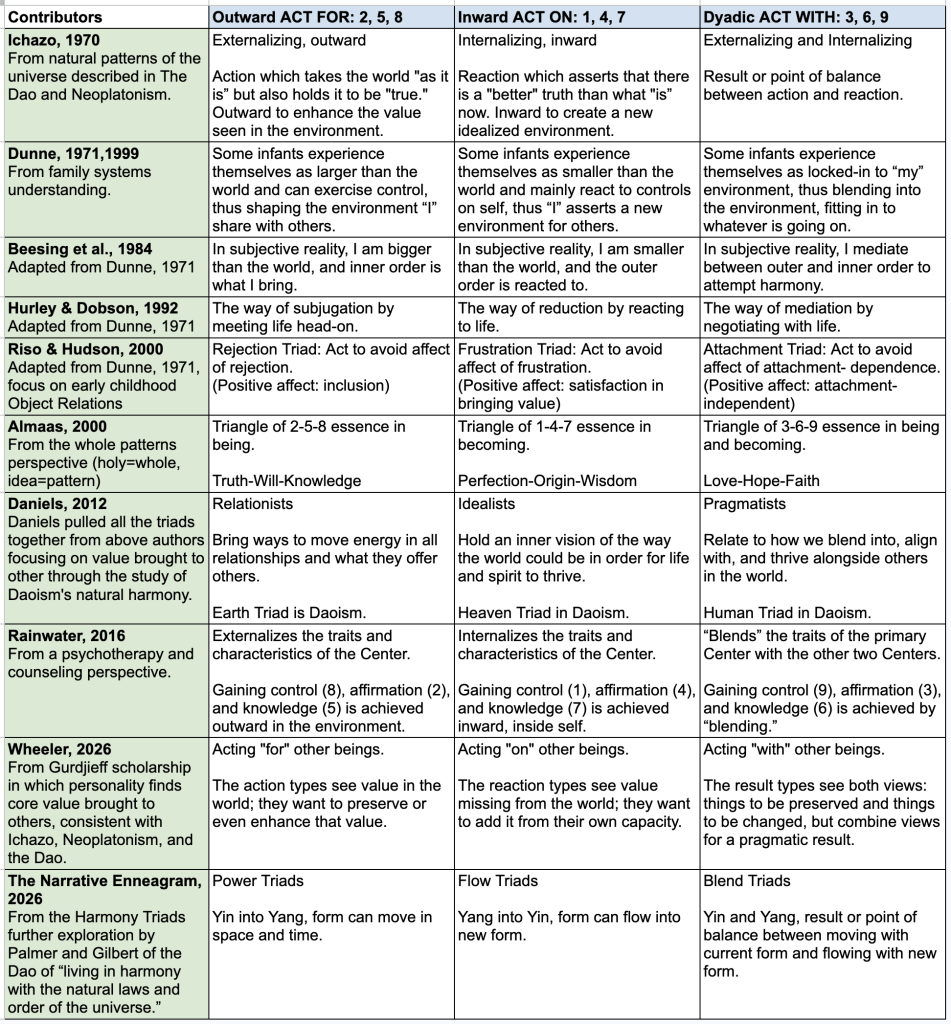
A central contribution of David Daniels' Harmony Triads’ work is his distinction between healthier and more contracted or unhealthy expressions of the same adaptive orientation. An adaptive behavior may initially serve development effectively by bringing value to the child, others, or the surrounding environment. When that behavior becomes the habitual strategy through which the individual seeks acceptance, connection or security, it can become increasingly automatic, rigid, limiting, or overused. The next two sections further summarize this distinction between healthy and less healthy descriptions. This distinction is central to David Daniels’ contribution because it reframes the same underlying orientation as capable of adaptive, integrated expression or increasingly automatic and contracted expression.
The Emotional Regulation Triads – Shift, Contain, Express
The Role of the Emotional Regulation Triads – Provides Capacity for Resolution
Next are the three Emotional Regulation Triads (Figure 4). The capacity of mind to regulate emotions and modify them is key in resolving our experiences of rupture in relationships, larger conflicts, and other gaps of separation between what the self desires and what the environment presents (Daniels, 2012).
- Shift (Outward to Environmental Harmony): three patterns have a bias in the Body Center to restore harmony of the environment.
- Patterns 9, 2, and 7 reframe the environment as positive and harmonious, and shift-regulate their emotional state to resolve or reconcile problems, but can completely repress emotions in stress and reactivity.
- Healthy Resolution: Shift-regulating emotions without completely repressing them.
- Contain (Inward to Internal Rationale): three patterns have a bias in the Heart Center to assert a rationale solution from self, to do, and to accomplish.
- Patterns 3, 1, and 5 contain-regulate providing time to internally analyze, build rationale, and logic to resolve or reconcile problems, but can suppress emotions in stress and reactivity.
- Healthy Resolution: Down-regulating emotions so they are contained and present rather than suppressed
- Express (Dyadic to Cause and Effect): three patterns have a bias in the Head Center to reconcile cause and effect with knowledge.
- Patterns 6, 4, and 8 express-regulate voicing concerns and causes to uncover “data” and knowledge about the root cause of problems to resolve or reconcile problems, but can amplify and project emotions in stress and reactivity.
- Healthy Resolution: Up-regulating emotions enough for constructive expression and verbalization to uncover "what's really going on" and increase cause-effect knowledge rather than "amplified-potentially-destructive" emotions.
Triadic Structure of the Emotional Regulation Triads
As seen in Figure 4, the threefold pattern continues from the Center’s dominant bias of an outward, inward, or dyadic orientation based on its evolutionary purpose. The diagram connects core points 9, 3, and 6 to the wing points that use the emotional regulation modes of the Body, Heart, and Head Centers, respectively.
Figure 4. Emotional Regulation Triads (also called the Harmonic Triads)
- Body – Outward Shifting (Positive Outlook) – 9 body triangle lines to 2 and 7
- Heart – Inward Containing (Competency) – 3 heart triangle lines to 1 and 5
- Head – Dyadic Expressing (Reactive) – 6 head triangle lines to 4 and 8
Many Labels Describing the Emotional Regulation Triads (or Harmonic Triads)
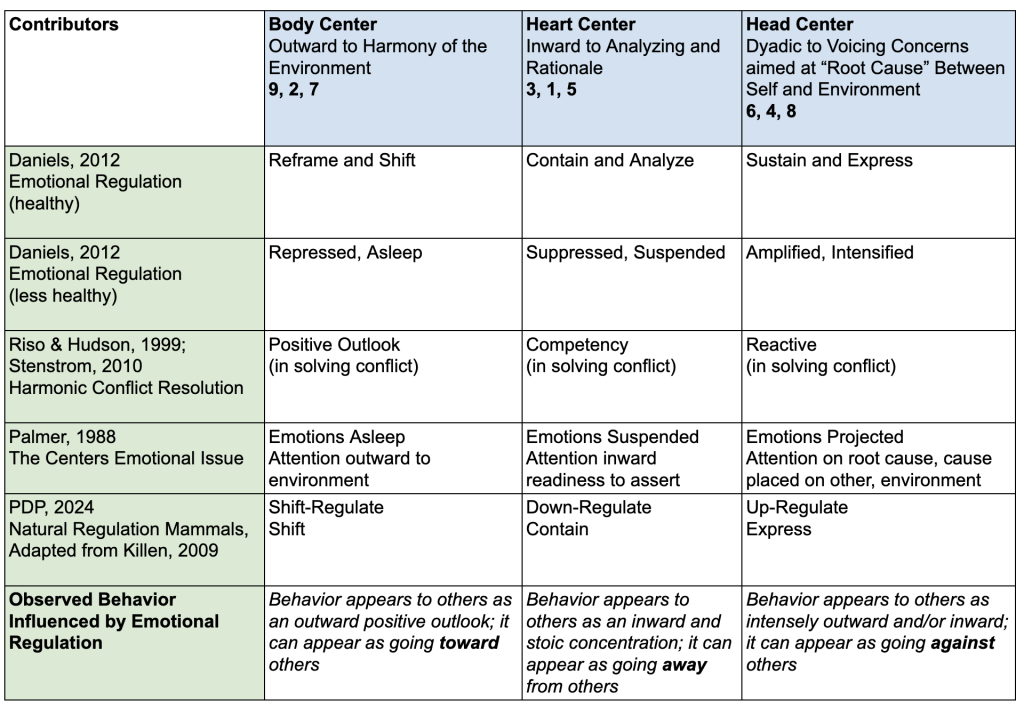
Table 4 outlines the various labels that have been used to understand the Emotional Regulation or Harmonic Triads, including healthier and less healthy labels. Emotional regulation also can impact the core behavior to ACT FOR, ACT ON, or ACT WITH others.
Table 4: Emotional Regulation (or Harmonic) Triads: Various Labels Yet Same Core Purpose -- Provides Capacity for Resolution
The Energy Regulation Triads – Receptive In and Down, Active Up and Out, Balancing
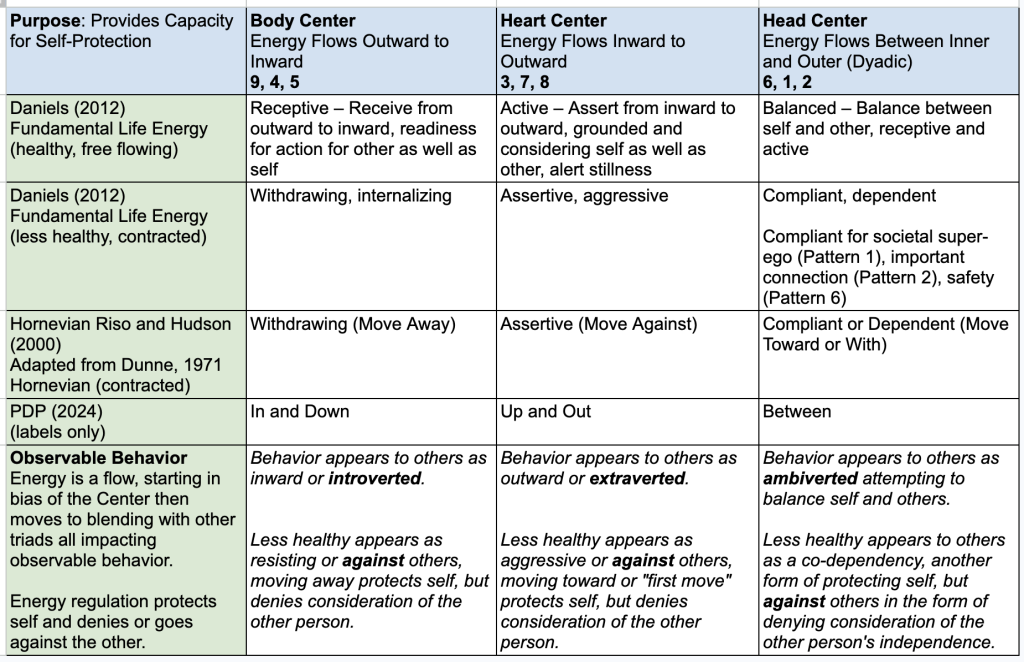
The Role of the Energy Regulation Triads – Provides Self-Protection
The Energy Regulation Triads serve to protect self and the flow of energy (Figure 5). However, in a reactive and stressed context regulation can become constricted, possibly decreasing the amount of free-flowing energy.
- Receptive (Outward to Inward Flow): three patterns have bias in the Body Center’s receptive energy which flows outward to in and down.
- Patterns 9, 4, and 5 receive the needs of the environment and others, but this receiving energy can also contract to withdrawing behavior.
- Healthy Available Energy: receptive and present energy without withdrawing, considers self and others.
- Active (Inward to Outward Flow): three patterns have bias in the Heart Center’s active energy which flows inward to up and out.
- Patterns 3, 7, and 8 lean into inner abilities to know what to do, but this decisive active energy can also contract to aggressive behavior.
- Healthy Available Energy: active and grounded energy without aggressive asserting from self, considers self and others.
- Balancing (Dyadic Flow): three patterns have bias in the Head Center’s balancing energy which toggles between self and others.
- Patterns 6, 1, and 2 look to balance and compromise, but this balancing energy can also contract to complying behavior to protect self (6 is dutiful for safety, 1 defers to societal super-ego, 2 is compliant to important others).
- Healthy Available Energy: balanced energy which takes in both self and others sans complying and co-dependency.
Triadic Structure of the Energy Regulation Triads
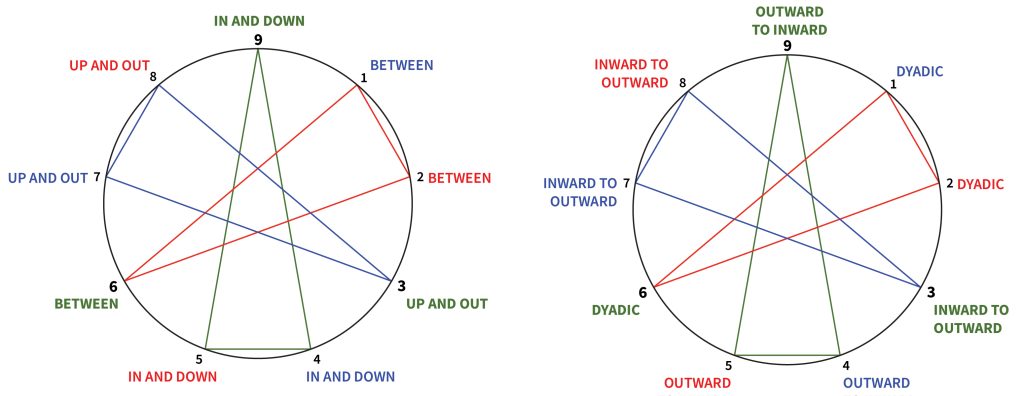
As seen in Figure 5, the threefold pattern continues from the Center’s dominant bias of an outward, inward, or dyadic orientation. The diagram connects core points 9, 3, and 6 to the wing points that use the energy regulation modes of the Body, Heart, and Head Centers, respectively.
Figure 5. Energy Flow Regulation Triads (also called the Hornevian Triads, see Table 5)
- Body – In and Down (or Withdrawing) – Outward to inward energy flow – 9 body triangle lines to 4 and 5
- Heart – Up and Out (or Asserting) – Inward to outward energy flow – 3 heart triangle lines to 7 and 8
- Head – Between (or Complying) – Dyadic attempt to balance energy – 6 head triangle lines to 1 and 2
Many Labels Describing the Energy Regulation (or Hornevian Triads)
Table 5 outlines the various labels that have been used to understand the energy regulation triads, including more and less healthy (Daniels, 2012). In addition, the labels of “against,” “away,” “toward,” and “with” have been used in different contexts by various authors, also causing confusion particularly when used to describe behavior (see the last row of Table 5).
Finally, energy regulation modes influence observable behavior. For example, Patterns 2, 5, and 8 “ACT FOR” others, behaving to provide protection, meet needs, and provide knowledge for others. However, Pattern 8 energy is up and out, Pattern 5 is down and in, and Pattern 2 toggles between balancing needs of important others and of self.
Table 5: Energy Flow Regulation (or Hornevian) Triads: Various Labels Yet Same Core Purpose -- Provides Capacity for Self-Protection
Developmental Pathways Based on the Enneagram as a Comprehensive System: One to Three to Nine to 27
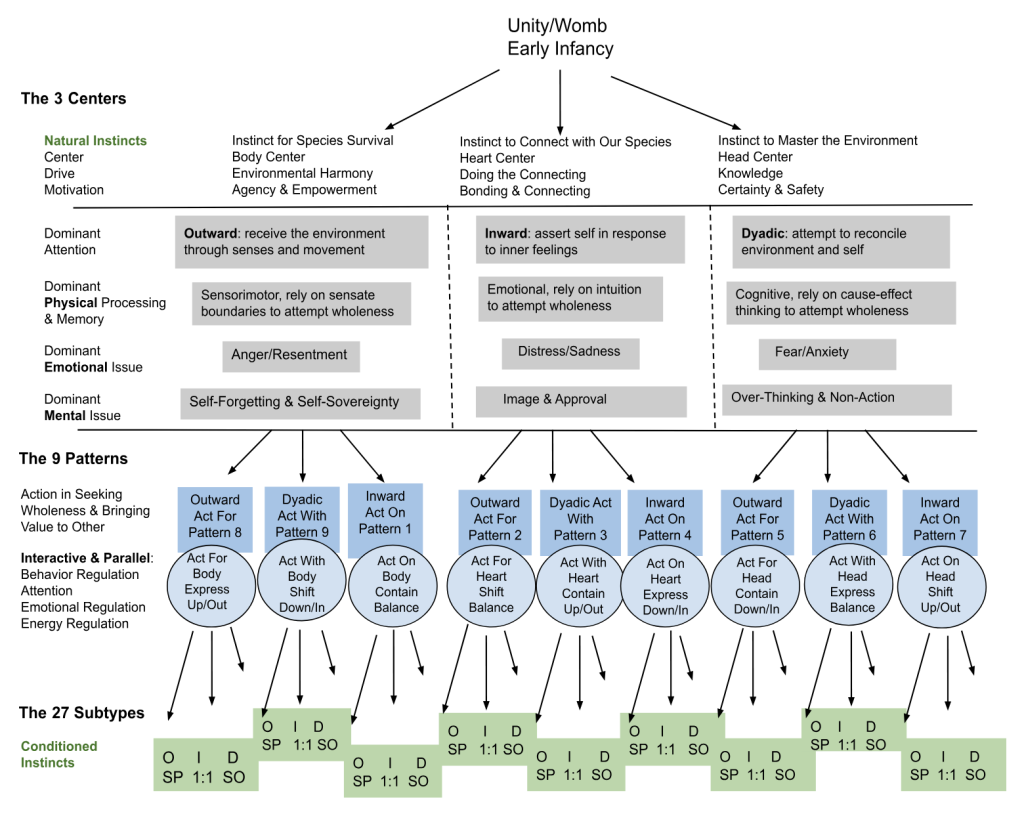
With the three survival instincts and four triads described, this section builds a framework of developmental pathways (Figure 6) which includes all elements of the Enneagram Personality System. The descriptions of development are based on the Enneagram tradition.
The framework starts with the operation of the natural instincts or the operation of the three instincts before learned experience is stored in memory. As the structure of nine personality patterns are formed by growing experience, coping mechanisms of personality distort the natural instincts into what Ichazo labeled as distorted or conditioned instincts, resulting in twenty-seven patterns.
- The three natural instincts of survival – instincts operating before learning/conditioning
- The three Centers of Intelligence Triads
- The Harmony Triads – Behavioral Regulation Triads
- The Emotional Regulation Triads
- The Energy Flow Regulation Triads
- The three “distorted” instincts of survival – instincts operating after learning/conditioning
The four triads are not four successive developmental stages, but rather an emergent system in which all the “separate” functions and orientations operate interactively, simultaneously, sequentially, and contextually.
The 1->3->9->27 pathway describes a proposed developmental differentiation of the Enneagram patterns–from wholeness to Centers, to personality patterns, to instinctual expressions. In contrast, the comprehensive system describes the interacting functional domains through which those patterns are regulated and expressed.
Figure 6: An Enneagram System Comprehensive Patterns of Developmental Pathways Framework
From 1 to 3: Undifferentiated beginning to 3 Centers of adaptive functions → 3 patterns
- In the Enneagram tradition, human development is described as beginning with an experience of unity or undifferentiated wholeness, often called being. Following birth, we lose contact with this wholeness of being (Ichazo, 1982a; Almaas, 2000).
- As we develop, the sensate experience of separation leads to our attempts to restore wholeness. One of our primary Centers of Intelligence is relied upon in attempting to close the gap between "self” and "environment” based on our natural instincts embedded in temperament.
- Each of the Centers of Intelligence has physical, emotional, and mental habits, but some come to be relied on more than others.
From 3 to 9: 3 Centers x 3 Behavioral Orientations → 9 patterns
- In perceived separation from the world, there are only three ways to build confidence to act and each Center divides into:
-
- ACT FOR the world
- ACT ON (Improve On) the World
- ACT WITH the World
-
Embedded in the Harmony Triads we see our strengths and inherent value we bring to others and the world. However, this habit of action when compensated as our strategy to receive love can become contracted, fixated, over-compensated, and thus also become our weakness causing hurt and harm to both self and others, potentially in relation to attachment security and other developmental conditions.
- From here there are fundamental modes for regulating emotions and energy. If our initiating Center of Intelligence fails to close gaps between internal state and the environment, the framework proposes that emotional regulation may be recruited to resolve the discrepancy. Energy regulation (serving to protect us and our energy expenditure while simultaneously denying others and the environment) may occur subsequently or in parallel. Energy regulation in a flow from outward to inward or inward to outward, or balancing appears as Introversion, Extraversion, or Ambiversion, impacting how the behaviors of ACT FOR, ACT ON, and ACT WITH are visibly observed.
The Enneagram also identifies nine defense mechanisms that “glue” the personality structure together. The nine defense mechanisms also follow the threefold recurring pattern of the Emotional Regulation Triads:
2-7-9 repressing – asleep to conflict but at the same time producing it through omission (outward)
-
- Pattern 2 – Repression - avoids hurtful conflict.
- Pattern 7 – Rationalization - avoids hurtful blame.
- Pattern 9 – Narcotization - avoids hurt, period.
1-3-5, suppressing – retreating from conflict (inward)
-
- Pattern 1 – Reaction Formation - hides the inner state and replaces it with calm.
- Pattern 3 – Identification - hides the inner state and replaces it with image of worthiness.
- Pattern 5 – Isolation - hides the inner state by retreating into logic.
4-6-8 expressing/amplifying –- moving in on conflict to understand the cause (dyadic)
-
- Pattern 4 – Introjection - projects contrition (My fault).
- Pattern 6 – Projection - attributes own failings to others (Your fault).
- Pattern 8 – Denial - projects righteous strength, regardless (No fault).
From 9 to 27: 9 Behavioral Patterns x 3 Conditioned Instincts → 27 patterns
- As a conditioned personality develops, the natural instincts become distorted (serving self, rather than the species). Best known by Naranjo’s labels the distorted instincts are Self-Preservation (me over other members of my species), One-on-One (exclusive connection, care, and focus on only some members of my species), and Social (a cover up for not contributing to the group’s effort to adapt to the environment) (Lilly and Hart, 1975; Ichazo, 1982a, 1982b). This is a further interaction and differentiation of each pattern. The 27 subtypes are not proposed as a third independent developmental stage; rather, they represent further differentiation in the expression of each of the nine patterns according to which conditioned instinct becomes most distorted or contracted to operate for self (rather than for self and others).
In Summary
Innate temperament and environmental experience, on aggregate, contribute to our personality. However, when looking at individuals, their particular genetics, specific traumas, and unique challenges, the balance of inborn temperament and environment could be weighted differently. Within this framework, secure attachment is hypothesized to support a more flexible or “softer” expression of the habitual personality pattern, whereas insecure attachment may contribute to a more “fixated” expression of the habitual pattern, whereas insecurity may contribute to a more rigid or fixated expression. In the Enneagram tradition, both healthy and less healthy personality habits remain on autopilot or drawn attention until controlled attention enables a sustaining witnessing of our machine-like pattern.
Comparing Patterns of Developmental Pathways: The Enneagram Harmony Triads and the Attendency Triads
In the book Personality and Wholeness, the PDP Group formed a working hypothesis on a developmental pathway from three motivational Vectors to nine personality patterns. The PDP hypothesis used data from the Centers Triads and the Emotional Regulation Triads. From here, we created a hypothesis that would link the three Centers or Vectors to the nine patterns. We called this hypothesis Attendency in which attention, energy, and behavior channel in the same direction. We had the inward, outward, and dyadic pattern from the Enneagram tradition, but behavioral regulation and energy regulation came from an educated guess, and not the triadic structure. The broader, comprehensive system of the Enneagram tradition starts with a behavioral orientation of value and that the capacity of mind to monitor, modify, and modulate behavior can change the direction of attention and energy in how that behavior is manifested.
Energy Follows Attention, Regulation May Change It
Energy does follow attention, until regulatory capacities of the mind change the direction. Thus, inward, outward, and dyadic can change with behavior regulation of the Harmony Triad, emotional regulation and energy regulation.
As mentioned above, the PDP Group working hypothesis came from the use of two Enneagram triads. There are slight differences in predictions of behavior when we use all four sets of triads:
- The Centers Triads (or Vector triads),
- The Action or Behavior Regulation Triads (a “contemporary” label for the Harmony Triads),
- The Emotional Regulation Triads, and
- The Energy Flow Triads.
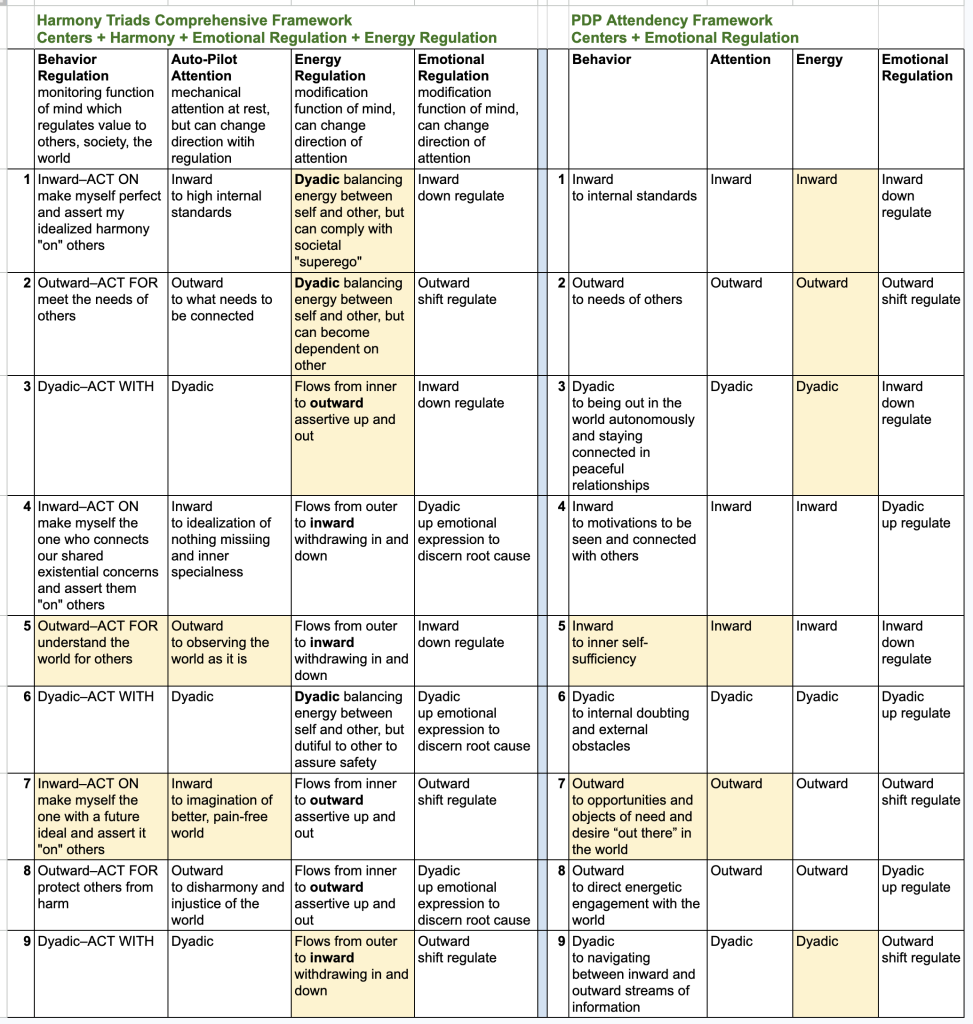
Table 6 shows the predictions of the Enneagram’s threefold recurring patterns with four triads (Centers/Vectors, plus three more triads) and the Attendency hypothesis with two triads, (Centers/Vectors, plus one triad for emotional regulation).
Yellow highlights show slight differences in the resulting pathways from the three Centers/Vectors to the nine patterns of personality when four versus two triads are included.
Table 6: Predictions Based on the Enneagram’s Triadic Recurring Pattern vs. Predictions Based on the PDP’s Attendency Hypothesis
Patterns 5 and 7: Taking Another Look
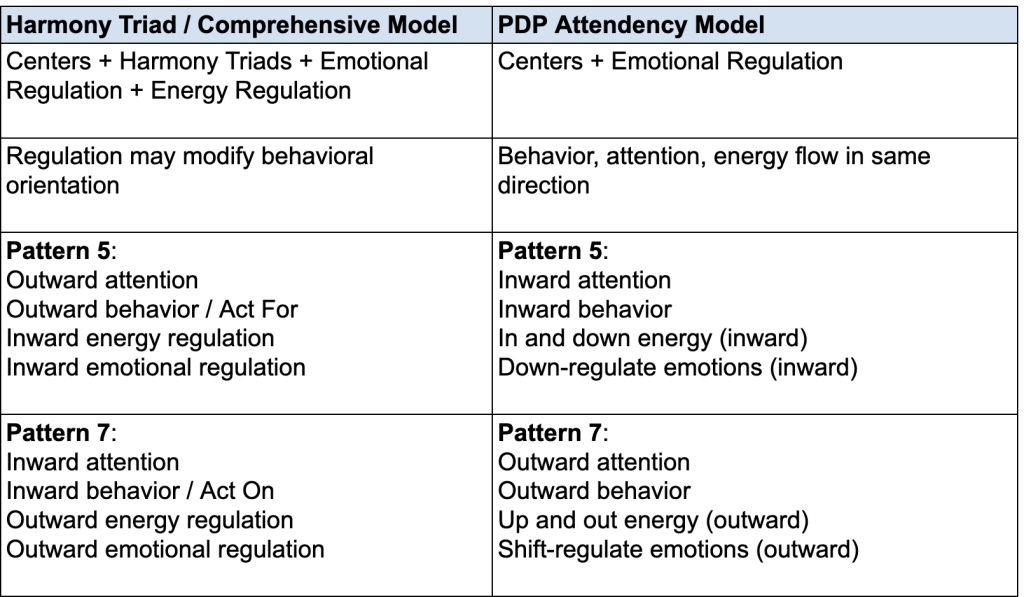
Pattern 5, the Observer or Investigator, has a bias in outward attention to observing, watching, and investigating, with behavior oriented to gathering knowledge and understanding the world as it is, but their energy draws inward (in and down). On the other hand, Pattern 7, The Epicure or Visionary, has a bias in inward attention to imagination and envisioning a “pain-free” world, with behavior oriented by turning inward to a new vision for the future, but their energy asserts outward (up and out).
Table 7 reveals a more complex answer, and more about the “mixing and matching” of using more than one center or Motivational Vector for the “wing” points. It highlights the impact of both energy and emotional regulation on behavior. The behavior orientation for Pattern 5 is outward in the form of understanding the world for others, but both energy and emotional regulation impact how that behavior manifests in an inward and quiet manner. Likewise Pattern 7 organizes their behavior around internal visions of the future but both energy and emotional regulation create an assertive, up and out, upbeat manifestation of the behavior.
This resulting divergence between core behavioral orientation and regulatory expression provides a specific empirical question for distinguishing the Harmony Triad/comprehensive framework from the earlier PDP Attendency framework.
Table 7: Looking at Pattern 5 and 7 Behavior, Attention, Energy Regulation, Emotional Regulation
Matrix of the Four Triads
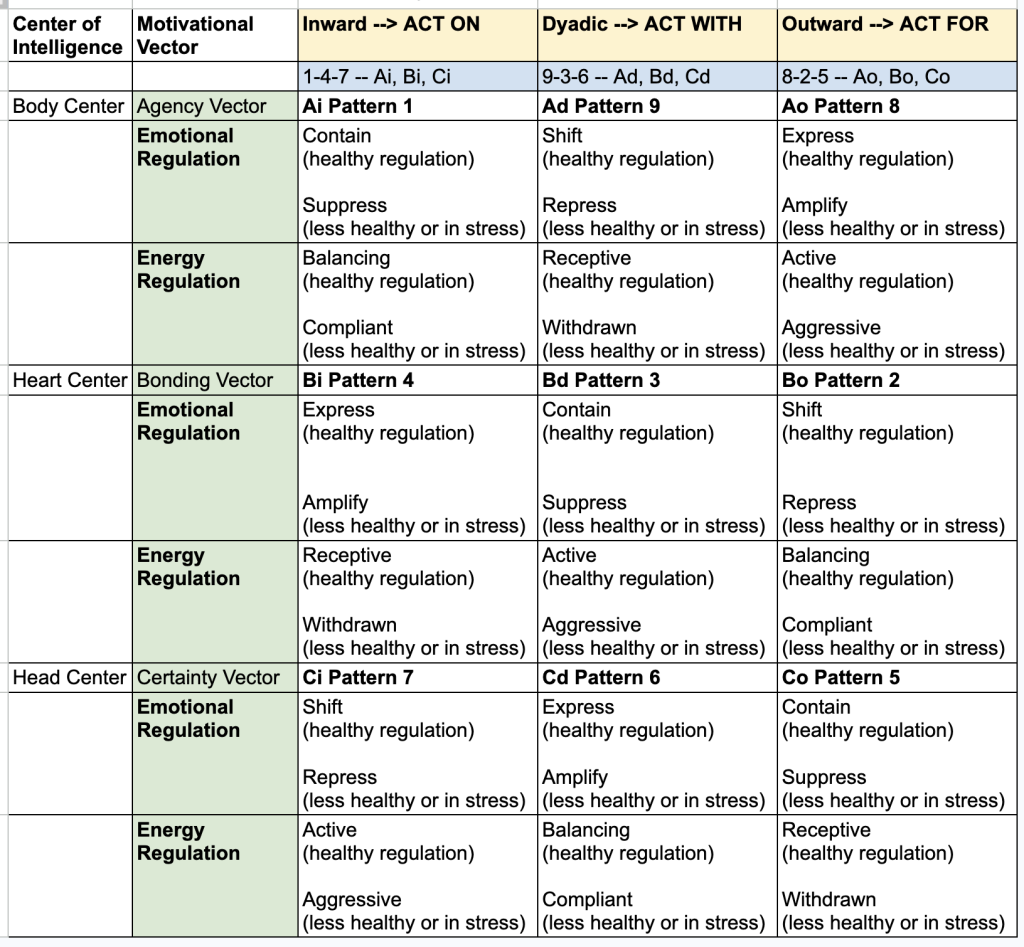
As seen in Table 8, labels used to describe healthy and less healthy forms of regulation are vital in clinical work and measurement.
Table 8: A Matrix of All Four Enneagram Harmony Triads: Discerning Healthy versus Contracted and/or Reactive Regulation
Conclusion
This article revisited the Patterns of Developmental Pathways framework through David Daniels’ contribution to the Harmony Triads and the source knowledge of the Enneagram’s triadic structure brought forward by Gurdjieff and Ichazo. It describes two related ideas: first, that the Harmony Triads provide a developmental bridge from the three Centers of Intelligence to the nine Enneagram personality patterns; and second, that the Harmony Triads are best understood within a broader comprehensive Enneagram System, in which behavioral orientation, emotional regulation, energy regulation, and instinctual processes interact. The developmental sequence is thus 1→3→9→27, while the comprehensive system describes the interacting functions through which these patterns are expressed and regulated.
Developmental Pathways and Interactive Functions Within a System
The study of the Harmony Triads presents a system of developmental pathways and interactive functions. Within the framework presented here, the three Centers of Intelligence represent broad adaptive functions associated with conservation, relation, and adaptation. Each Center can differentiate into three behavioral orientations – ACT FOR, ACT ON, ACT WITH–yielding nine personality patterns. These patterns may then further differentiate through three conditioned instinctual orientations, yielding the 27 subtypes. At the same time, the four triadic domains–Centers of Intelligence, behavioral orientations, emotional and energy regulation–do not represent four successive developmental stages. Rather, in the Enneagram tradition they are seen to operate interactively and contextually, most often simultaneously and sometimes sequentially, with each contributing to how an underlying behavioral orientation is organized, regulated, and expressed.
David Daniels’ distinctive contribution is especially important in distinguishing healthier and more contracted expressions of these orientations. An adaptive strategy may initially help an individual meet developmental needs and bring value to others, yet become increasingly automatic, over-used, and defended against. This distinction allows personality to be understood not simply as a collection of traits, but as a dynamic pattern of adaptation that can vary in flexibility, awareness, regulation, openness, and freer-flowing energy.
Triadic Structure: A Science of Patterns
The recurring, triadic structure of the Enneagram is consistent with a much older contemplative recognition that human experience and human consciousness organize themselves through recurring patterns rooted in whole systems dividing into three. And, for the development of personality, wholeness in three derives from three natural species survival instincts–Conservation, Relation, and Adaptation–using Ichazo’s labels interacting with the only three orientations to the world that are possible when we perceive ourselves to be separate–outward, inward, and dyadic. What is especially interesting is how the Enneagram triads may therefore offer a bridge between a science of patterns and the empirical sciences' study of complex biological and relational systems. When the triadic structure within the comprehensive system of the Enneagram of Personality is considered, it suggests future study of the Enneagram may benefit from utilizing system science as well as systems theory approaches capable of examining interacting, nonlinear, nested, and self-organizing patterns and processes.
The Importance of Labels and Language
The labels we use can obscure as well as clarify. We may be talking about the same function while using different terminology from diverse fields of psychology, different lines of scientific research, and various contemplative traditions. Karen Horney's triads of coping mechanisms energetically express how we cope and attempt to get our needs met: withdrawing, asserting, and complying, for example, which initially look quite different from the triad of the basic life flow of energy: receptive–in and down, active–up and out, attempting to balance. Or in stress-survival mode in which energy regulation that serves to protect us takes the survival reflexes form: flight/withdraw, fight/assert, freeze/feint/attempt to balance. This is indeed a key contribution in Daniels’ Harmony Triads work.
Further, what is even more clarifying is that each of the four triads have been described with labels and descriptions from Ichazo and later from Naranjo/Ochs/Dunne and then Riso/Hudson who used Karen Horney’s Object Relations labels. Ichazo came forward with Outward, Inward, and Outward-and-Inward (also Action, Reaction, Result), Object Relations with Toward, Away, and Against, and the PDP with Outward, Inward, and Dyadic. All these labels describe that there are three ways a perceived separate self can orient itself to the environment. Future research must dig deep into understanding the various labels assigned to the Enneagram’s triadic structure. In addition, it is useful to see that all four triads are Object Relations describing how the person organizes experience in relation to self, others, and the environment. The tables of labels throughout this article and in the Appendices will assist toward that end.
Revisiting the PDP Framework
The Patterns of Developmental Pathways (PDP) framework attempted to bridge the ancient knowledge of the Enneagram with contemporary affective neuroscience and developmental psychology. By translating Enneagram nomenclature into the language of contemporary science, the PDP framework generated valuable insight into motivational systems. Revisiting Daniels’ work on the Enneagram Harmony Triads brought forward additional dimensions of the Enneagram system that were not incorporated into the PDP framework and led to reconsidering some of the developmental pathways the PDP Group proposed. Comparing the Enneagram Harmony Triads with the earlier PDP Attendency framework reveals a specific difference in the predicted organization of Patterns 5 and 7. The Harmony Triad model places Pattern 5 in an outward ACT FOR orientation and Pattern 7 in an inward ACT ON orientation, while emotional and energy regulation may modify how those orientations appear behaviorally. This distinction provides a concrete example of how incorporating multiple interacting triads can yield different predictions from a model based on fewer regulatory dimensions.
Implications for Future Research
Since the turn to the 21st Century, each year brings an increasing volume of empirical research taking place on the Enneagram – both the effectiveness of measurement and the efficacy of using the Enneagram patterns in counseling and therapy, education, organizational development, and for self-development. An international empirical literature on the Enneagram is emerging, and its size, quality, and conclusions are beginning to be characterized through systematic review. To that end, Appendix C provides insight on both measurement and predictions about human behavior.
With the focus of this article on the recurring triadic structure of the Enneagram, this article also serves as an invitation to study the Enneagram as a formal mathematical science, including recurring patterns, fractal patterns, physical and mathematical laws, and formal systems theory. Indeed, in the last ten years, the behavioral sciences have increasingly leaned toward data sciences in which patterns emerge from data sets and their structure is studied, in contrast to hypothesizing a pattern and verifying through statistical significance. Our past science of patterns sought to study the wholeness of the human condition. The Enneagram is a result of Greek, Egyptian, Indian, Chinese, and Babylonian science and mathematics (verified outside our contemporary academic academy). These scientists and mathematicians placed two key discoveries about the human condition in the Enneagram diagram. It first describes the development of personality with a fundamental pattern of three survival instincts interacting through the only three orientations to the environment possible in which we perceive separateness from others, the environment, and the whole. Second, the Enneagram diagram describes a discovery of a process of seven stages leading to wholeness or completion.
Complementary Eastern and Western Psychological Science
A broader view suggests an important opportunity for dialogue between contemporary psychological science and the Enneagram’s science of patterns. The Enneagram’s triadic structure across motivation, attention, information filtering, memory associations, emotion, cognition, somatics, and behavior has the potential to inform the empirical sciences, while contemporary science provides methods for investigating how these psychological processes can be measured, interact with one another, and change across time. Here the Enneagram describes the nature of the “whole elephant” and empirical science by its nature, studies predictions based on specific parts of the whole under certain conditions – “what are the functions of an elephant's trunk” or “how does a mother elephant communicate affection to her infant utilizing her trunk.” To measure the Enneagram patterns using specific dimensions could describe parts of a person. To measure the whole of a person it is likely that a detailed description of 27 clusters of specific features are needed to control for the “echo effect” of the triadic structure, in which orientations of confidence to act outwardly, inwardly, or dyadically layer on each other. And, because the Enneagam captures the inner workings of personality, it requires study of people who have developed “awareness of awareness” – using an inner observer to watch thoughts, feelings, and sensations. (Equally so, a scientist can increase objectivity by identifying which of the 27 Enneagram subtypes bias their hypothesis, data collection, data analysis, and data interpretation.)
Turning to clinical practice, Western psychology, similar to Western medicine, has primarily focused on symptoms and coping mechanisms. Eastern psychology is grounded from a different place, not only descriptive of how we cope—which is incredibly useful, but how we become free from the patterns through which we have adapted and learned to cope. The Eastern psychology of the Enneagram also emphasizes the curative potential of consciousness – the possibility of becoming less identified with habitual patterns through sustained awareness. Bringing the two perspectives into dialogue allows us to consider both how patterns may function as adaptive forms of self-organization and how they may become limiting when they operate rigidly or outside awareness.
Side Notes
Notes and Acknowledgements
Reviewers and Contributors: Laura Baker, Suzanne Dion, Steven Wheeler
This article was written by Denise Daniels, Ph.D. and in alignment with the contribution to the Enneagram Harmony Triads by David Daniels, M.D. and Enneagram knowledge brought forward by Gurdjieff and Ichazo. The views and opinions expressed in this article do not necessarily reflect the views or positions of other members of the PDP Group.
Please write to Denise Daniels about any questions or to set up a discussion: denise@drdaviddaniels.com
Background to this Article
After the book, Personality and Wholeness, by Daniel Siegel and the PDP Group was released at the end of 2024, I was contacted by Enneagram scholars, clinicians, and teachers, certified in the Enneagram Institute and the Narrative Enneagram, with an interesting issue. Why did the PDP Group place Pattern 5 with a bias in inward attention and Pattern 7 with a bias in outward attention?
In addition, I was asked to explore the asymmetrical Attendency triads of 1-4-5 (inward) and 8-2-7 (outward) compared to the symmetrical Harmony Triads 1-4-7 (inward) and 8-2-5 (outward) (Figure 7).
Figure 7: Attendency Hypothesis and Enneagram Threefold Recurring Pattern
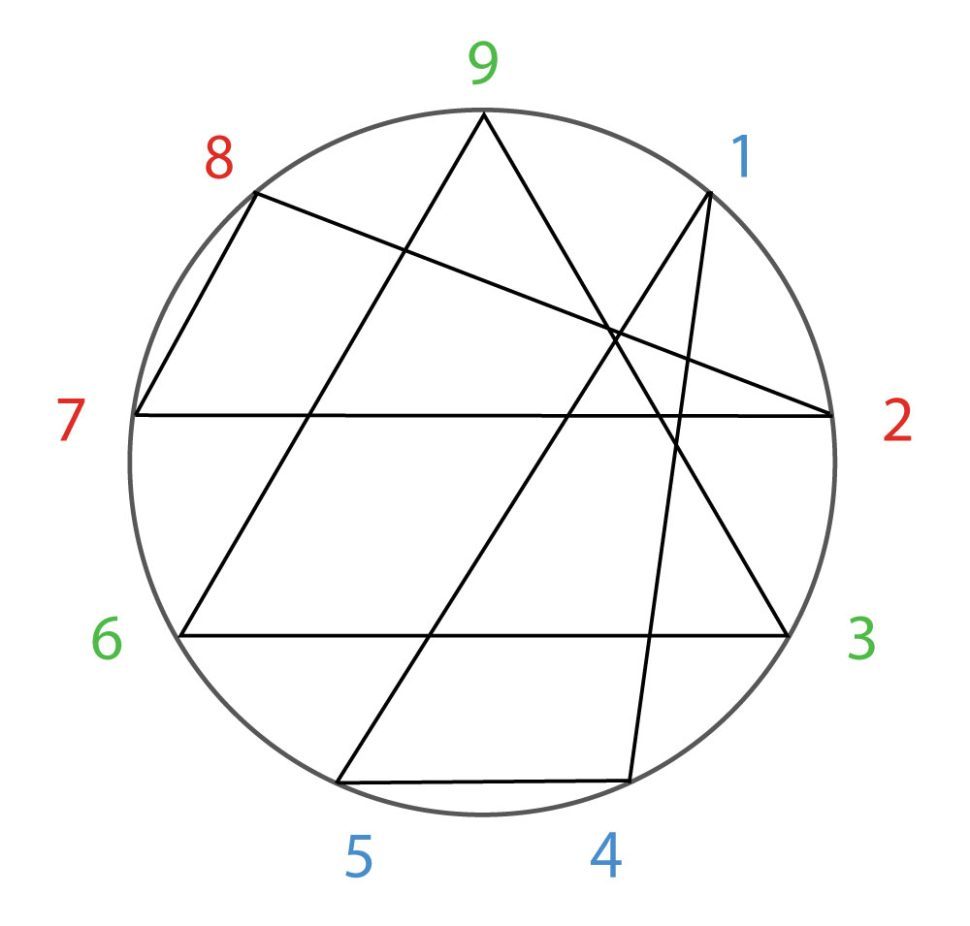
Attendency Hypothesis: From Three Vectors of 9-3-6 to Nine Patterns: Outward 8-2-7, Inward 1-4-5, and Dyadic 9-3-6
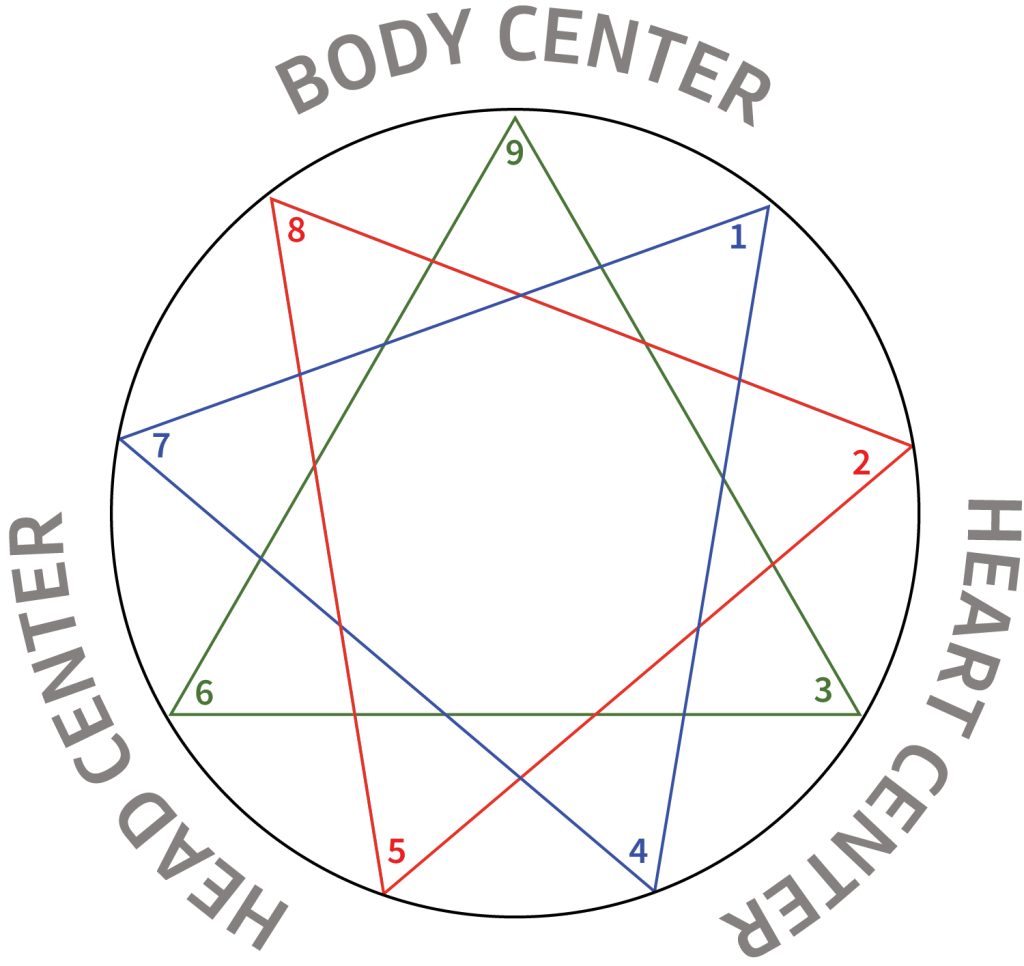
Enneagram Triadic Recurring Pattern: From Three Centers of 9-3-6 to Nine Patters: Outward 8-2-5, Inward 1-4-7, and Dyadic 9-3-6
So….. why this article?
Honoring Dr. David Daniels. First and foremost, is a sense of responsibility to my father who recognized the pathway to nine patterns formed by the three Harmony Triads, which he had not communicated to the PDP Group before his passing.
Verification Outside the Academic Academy. Second, is an acknowledgement to the contemporary Enneagram community of scholars and clinicians who have observed, taught, and refined these patterns over a 60 year period, albeit outside of the academic academy.
Science and Datasets. Third, is my responsibility as a scientist to communicate the PDP Group’s limited data set. Each of the four sets of triads – the Centers, the Harmony Triads, the Emotional Regulation Triads, and the Energy Regulation Triads have an outward, an inward, and a dyadic version. The PDP Group included two of the four triads in our work. This is a factor I did not fully understand until after the book was published and feel a responsibility to share this new knowledge and data with the PDP Group, clinicians, teachers, and researchers around the world.
References
Abdelhamid, E. A., Ismail, S., & Aref, M. (2023). Architecture for personality detection using enneagram knowledge: case study. International Journal of Intelligent Computing and Information Sciences, 23(1), 18-28.
Almaas, A. H. (2000). Facets of Unity: The Enneagram of Holy Ideas. Shambhala.
Beesing, M., Nogosek, R., and O’Leary, P. (1984). The Enneagram: A Journey of Self-Discovery. Dimension Books.
Daniels, David. (2012, October). The Enneagram’s Harmony Triads. Enneagram Association of Narrative Teachers Conference and Newsletter, Washington D.C.
Daniels, David. (2010-2026). The Enneagram Triads: Working with the Enneagram Harmony Triads. https://drdaviddaniels.com/the-enneagram-triads/
Daniels, David and Dion, S. (2025). The Enneagram, Relationships, and Intimacy. Morgan James Publishing.
Daniels, Denise and Wheeler, S (2026). The Mathematical and Physical Structure of the Objective Enneagram of Personality and Consciousness. The Objective Enneagram Project. https://theobjectiveenneagram.org/part-2-the-objective-enneagram-of-personality-consciousness/
Devlin, K. (2003). Mathematics: The science of patterns: The search for order in life, mind and the universe. Scientific American Library. (Originally published 1994)
Dunne, Tad. (1999). Enneatypes, Method & Spirit: Our Nine Basic Compulsions. Universal Publishers/uPUBLISH.com, (Describes 1971 teachings).
Gurdjieff, G. I. (1950). Chapter 30: Art. Beelzebub’s Tales to His Grandson: An Objectively Impartial Criticism of the Life of Man. Hartcourt, All and Everything First Series, Arkana, 1999. 449-523.
Gurdjieff, G. I. (1963). Meetings with Remarkable Men. Routledge, All and Everything Second Series, Arkana, 1991 (original publication 1963).
Gurdjieff, G. I. Life Is Real Only Then, When “I Am.” (1981). Dutton, All and Everything Third Series, Arkana, 1999 (original publication 1981).
Hurley, K. V., and Dobson, T. E. (1992). What’s My Type? Use the Enneagram System of Nine Personality Types to Discover Your Best Self. 1. ed, Harper.
Ichazo, O. (1982a). Breaking the Tyranny of the Ego: Interview by Sam Keen in Psychology Today, 1973. Interviews with Oscar Ichazo. 1st ed., Arica Institute Press, 3-24.
Ichazo, O. (1982b). Lecture The Collegiate College London 1981. Between Metaphysics and Protoanalysis: A Theory for Analyzing the Human Psyche. 1st ed., Arica Institute Press, 69-88.
Ichazo, O. (1993). Oscar Ichazo Breaks his Silence About a Powerful Nine-Pointed Symbol and the Battle to Control It: Interview by Michael Goldberg. Metro Santa Clara’s Weekly Newspaper, November, 14-21.
Ichazo, O. (2024a). The Enneagrams of Divine Forms. The Oscar Ichazo Foundation.
Ichazo, O. (2024b). The Enneagrams of the Fixation. The Oscar Ichazo Foundation.
Jenlink, P. M. (2022). Mathematics as the science of patterns. Convergence. Journal of the American Mathematical Association, maa.org
Killen, J. (2009). Toward the Neurobiology of the Enneagram. TALK, Journal of the AET & The Enneagram Journal, Volume 2.
Lilly, J. and Hart, J. (1975). The Arica Training (1970). Transpersonal Psychologies. Tart, Charles (Ed.) Psychological Processes.
Naranjo, C. (1990). Ennea-Type Structures: Self-Analysis for the Seeker. Gateways/IDHHB Inc.
Nicoll, M. (1952-1956). Psychological Commentaries on the Teaching of Gurdjieff and Ouspensky, Volumes 1-5. Vincent Stuart Ltd.
Ouspensky, P. D. (1949). In Search of the Miraculous: Fragments of an Unknown Teaching. Harcourt.
Ouspensky, P. D. (1950). The Psychology of Man’s Possible Evolution (1933 Lectures). 2. ed., Vintage Books, 1974, 1. ed., 1950 Hedgehog Press.
Ouspensky, P. D. (1971). The fourth way: A record of talks and answers to questions based on the teaching of G.I. Gurdjieff. Vintage Books. (Original work published 1957)
Palmer, H. (1988). The Enneagram: The Definitive Guide to the Ancient System for Understanding Yourself and the Others in Your Life. Harper Collins.
Palmer, H. and Gilbert, M. (2026). Making Connections: An Introduction to the Enneagram Triads. The Narrative Enneagram. https://www.narrativeenneagram.org/making-connections-an-introduction-to-the-enneagram-triads/
Quinn, J. (2022). What is mathematics? Focus. Journal of the American Mathematical Association, President’s Address, August/September Issue. maa.org
Rainwater, M. (2016). Enneagram Empowered Therapy. https://enneagramempowered.com
Riso, D. and Russ H. (2000). Understanding the Enneagram: The Practical Guide to Personality Types. Rev. ed, Houghton Mifflin.
Siegel, D., Baker, L., Daniels, D., Daniels, D., & Killen, J. (2024). Personality and Wholeness in Therapy. Norton Press.
Smith, Russell A. (1993). Gurdjieff, Cosmic Secrets. TheDog.
Steen, L. A. (1988). The science of patterns. Science, 240 (4852), 611–616. doi.org
Stenstrom, J. (2010). The Triadics and the Objectivity of the Enneagram. International Enneagram Association. https://ieaninepoints.com/2010-the-triadics-and-the-objectivity-of-the-enneagram/
Wheeler, S. (2025). Law Conformable. Notes from a Small Village, https://stevenwheelerblog.wordpress.com/2025/10/05/law-conformable/
Wheeler, S. (2026). Personality Types. Notes from a Small Village, https://stevenwheelerblog.wordpress.com/2026/02/06/personality-types/#more-9201
Wheeler, S. (2026). Notes from a Small Village, https://stevenwheelerblog.wordpress.com/
Appendix: Implications for Empirical Study
In revisiting patterns of developmental pathways, Patterns 5 and 7 provide a useful initial test case because the Harmony Triad model and the earlier PDP Attendency model make different predictions about their primary behavioral and attentional orientations.
Within the comprehensive framework including the Harmony Triads, Pattern 5 is predicted to show an outward behavioral orientation (ACT FOR), expressed through understanding the environment and providing knowledge to others, while its emotional and energy regulation may draw attention and behavior inward when attempting to reconcile or resolve knowledge and/or protect self. Pattern 7 is predicted to show an inward behavioral orientation (ACT ON), expressed through internally generated possibilities and ideals, while its emotional and energy regulation may contribute to a more outward and assertive behavioral presentation.
The competing predictions could be examined using multiple methods, including self-report, Enneagram expert interviews and typing, behavioral tasks, and experience-sampling measures of attention, emotion regulation, and energetic flow into behavior. Important methodological challenges include (1) distinguishing a person's underlying behavioral orientation from the observable effects of emotional and energy regulation, (2) recognizing a scale of labels ranging from contracted or fixated to more healthy expressions, and (3) discerning how there are three layers of orientation in the recurring triadic structure of the Enneagram.
Regarding the second challenge, a study participant with Pattern 9, 2, or 7 might be so emotionally repressed that they might not recognize labels of reframing the environment or shifting emotions as the fixated state is operating out of awareness.
For the third challenge – outward, inward, and dyadic orientations require assessment at the level of the three Centers, then nine patterns, then 27 subtypes. For example, a Pattern 5 is predicted to have a dyadic attentional direction associated with the Head Center, an outward ACT FOR behavioral orientation within the Harmony Triads and an additional outward, inward, or dyadic emphasis associated with its instinctual subtype. A more detailed measurement framework, including possible approaches to identifying the nine patterns and 27 subtypes and distinguishing healthier from more contracted regulation, is provided in Appendix C.
Table 9: Matrix of the Three Centers, Nine Patterns, and 27 Subtypes
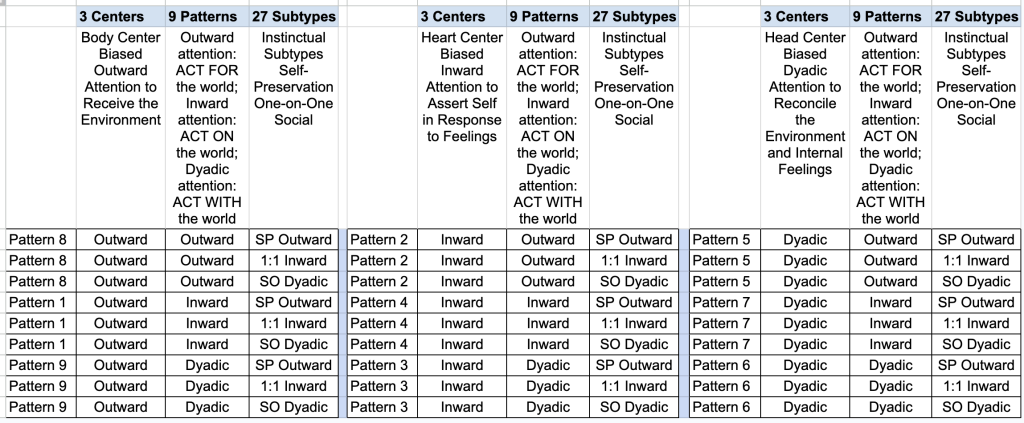
Finally, the matrix above sheds light on the rigor that needs to be employed in Enneagram measurement. At the minimum, a three step measuring model is suggested: (1) First, recruitment of study participants with the capacity for an “inner witness.” Because the Enneagram patterns are known from the inside, participants could be drawn from populations who have practiced mindfulness for at least five years. (2) Second, the next step in measurement would be a self-assessment or what Ichazo called autodiagnosis in which participants take an established reliable and valid Enneagram test (e.g., Riso-Hudson, Daniels-Price, or Wagner), then self-validate their pattern based on observing five person narrative panels of each of the nine patterns describing how their inner mind works. (3) Third, another layer of expert validation of the autodiagnosis by a minimum of three Enneagram interviewers with ten years of experience should be employed. Here, all experts would need to agree with the autodiagnosis for the participant to be included in the study. There may be a “magic bullet” to easily measure Enneagram type, but until then, the benefit to use reliable and rigorous validation seems critical to advance contemporary psychological science.
