
Personality & Wholeness: PDP Framework 2024 Developmental Hypothesis Rebuilt Based on the Enneagram Harmony Triads
Published: February 1, 2026 (Updated: April 2, 2026)
CORE ISSUE: Attendency is a mechanism of attention and energy flow in the PDP developmental model which explains how we develop from 3 centers to 9 patterns. Examination of the Harmony Triads indicates the PDP hypothesis requires correction for two patterns: Pattern 5 has bias in outward Attendency and Pattern 7 has bias in inward Attendency.
This article also describes the core behavioral pattern, revealed by David Daniels in his work on what he labels the "Harmony Triads." A young child, after numerous attempts to close the gap of separation between me and “not-me,” discovers an adaptive behavioral strategy (Act For, Act On, Act With) that is rewarded for bringing value to others, while also closing the gap of separation between internal state and external environment.
Importantly, the Harmony Triads mathematical fractal pattern does validate the developmental pathways for the other 7 patterns.
Note: This article is written by Denise Daniels, Ph.D. and in alignment with David Daniels' M.D. Harmony Triads work. “The views and opinions expressed in this article do not necessarily reflect the views or positions of other members of the PDP Group.”
It is further noted that this article is not a view or opinion, but rather based on the formal and objective mathematical science of the Enneagram as well as Gurdjieff and Ichazo scholarship which align with the Harmony Triads.
The data science revealing objective patterns in the Enneagram Harmony Triads will serve clinicians, researchers, and those in need of help, healing, and human potential.
Please write to Denise Daniels about any questions or to set up a discussion: denise@drdaviddaniels.com
Article Contents: Updated 2026 PDP Model
- How New Evidence About Attendency was Discovered
- Feedback Provided by Scholars in the Global Enneagram Community
- Study of David Daniels’ work on The Harmony Triads (2008-12) Reveals the Pathway from 3 Centers to 9 Patterns
- Brief Description in the Limitation of the 2024 PDP Attendency Hypothesis
- The Enneagram System is a Sum of All Parts Working Together
- The Enneagram Mathematical Structure Informs Biology
- Patterns of Developmental Pathways Framework Based on David Daniels' Enneagram Harmony Triads Work
- The Harmony Triads: All Three Centers and Biological Ecosystem Reciprocity
- An Enneagram Comprehensive Patterns of Developmental Pathways Framework
- Author Notes
How New Evidence About Attendency was Discovered
After Personality and Wholeness was released at the end of 2024, I was contacted by Enneagram scholars who observed a lack of specificity in our Attendency hypothesis, along with a confounding of energy flow and emotional regulation between Pattern 5 and 7. Admittedly, the PDP Group struggled with the concept of Attendency. We could see the attentional bias in certain types, but the articulation of the actual descriptions of Attendency in each pattern in the book is brief.
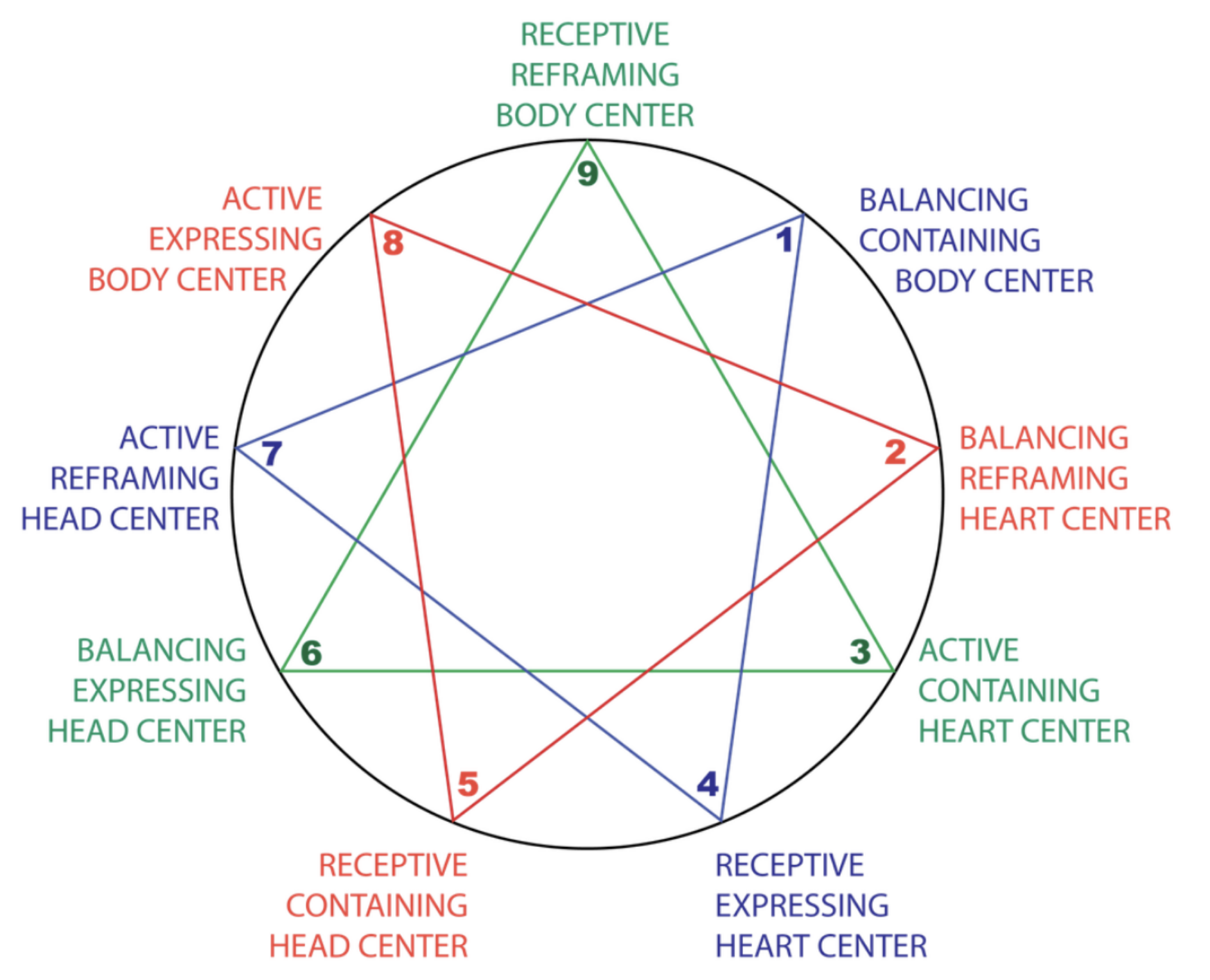
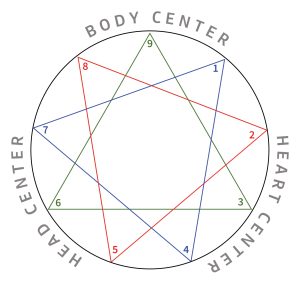
I decided to return to David’s writings which brought focus to what he discovered in the Harmony Triads (see Figure 1). I also accomplished an intense study of the original teachings of Ichazo and further discovered that David's Harmony Triads align with Ichazo's discovery. (In Author Notes at the end of this article, I document all the contributors to understanding the Harmony Triads, particularly those of Tad Dunne, Ph.D. 1971-73, a Jesuit, who taught two of the triads to Beesing, Nogosek, O’Leary, Hurley, Dobson, and Riso.)
Figure 1: The Harmony Triads, David Daniels, M.D.
Feedback Provided by Scholars in the Global Enneagram Community
To start, after the book, Personality and Wholeness, was released at the end of 2024, Enneagram scholars and therapists (Certified in both the Narrative Enneagram and the Enneagram Institute) notified me about two observations: (1) the lack of specificity in Attendency and (2) the confounding of Type 5 and 7 as related to Attendency, energy flow and emotional regulation.
Attendency is defined as: The orientation of attention and energy flow: The directionality of attention and energy that organizes the subsequent flow of attention and energy into behavior–either inward, outward, or dyadic.
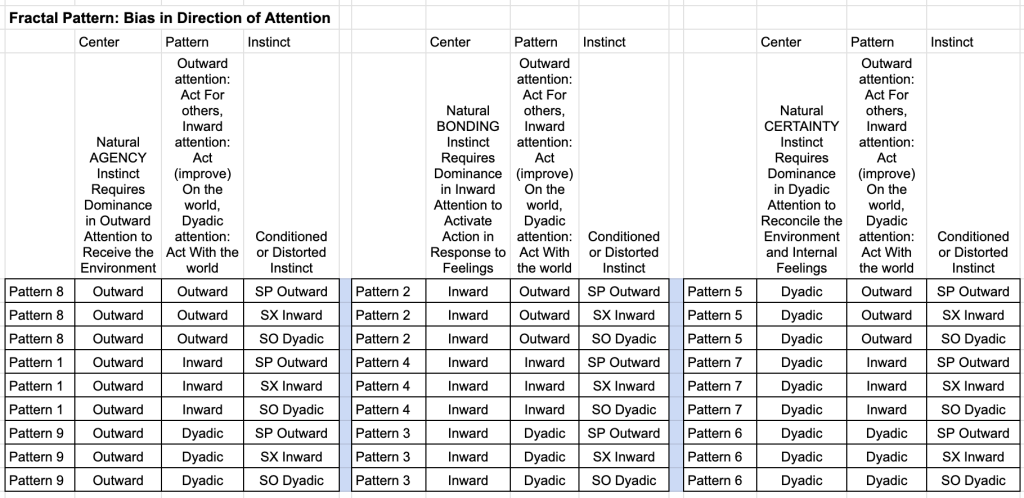
The mechanism of Attendency is very important and is seen throughout all Enneagram types, but is it fundamental or specific enough to understand the development from the 3 motivational Vectors to 9 patterns? Attention bias of inward, outward, and dyadic can crisscross as related to a layering of centers, types, and sub-types (see table in the Appendices at the end of this article).
The asymmetry of the PDP Attendency hypothesis revealed that placement with Patterns 5 and 7 were confounded with both the emotional regulation strategy triad and the energy flow regulation triad. (See Figure 1 above and compare to Figure 2 below.)
Figure 2: Asymmetry and Confounding of 2024 PDP Framework
PDP HYPOTHESIS ASYMMETRY
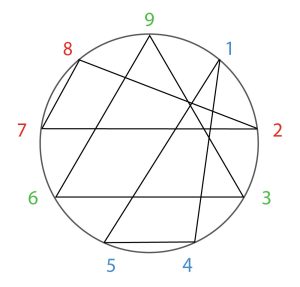
- Pattern 5 Certainty Inward -- Toward the states of readiness of psychological and material resources needed if danger comes --> incorrect, this should be C Outward
- Pattern 7 Certainty Outward -- Toward objects of need and desire out in the world --> Incorrect, this should be C Inward
Attendency Correction:
The Harmony Triads (described in the following section) reveal:
- It is Pattern 5, the Observer, who has an outward focus of attention and acts to understand the environment/world as it is, requiring an outward observing and investigation of how the world works.
- It is Type 7, the Epicure, who has an idealized inward focus of attention and acts by going in to anticipate what the environment/world will be improved by, requiring focus on internal vision and new possibilities.
RED triangle: Outward 2-5-8
BLUE triangle: Inward 1-4-7
PDP ATTENDENCY CONFOUNDING
3-6-9 DYADIC
1-4-'5' INWARD
- 5 inward could reflect “receptive"”or withdrawn energy in the Energy Flow Regulation Triad
- 5 inward could reflect “containing” in the Emotional Regulation Triad
2-'7'-8 Outward
- 7 outward could reflect "active" or assertive energy in the Energy Flow Regulation Triad
- 7 outward could reflect "reframing" in the Emotional Regulation Triad
Important Note: In the asymmetric hypothesis in the upper left hand column it can be seen that 1-4-5 and 2-7-8 have no connection to 3, 6, 9 that represent the 3 core centers with their 3 motivational Vectors.
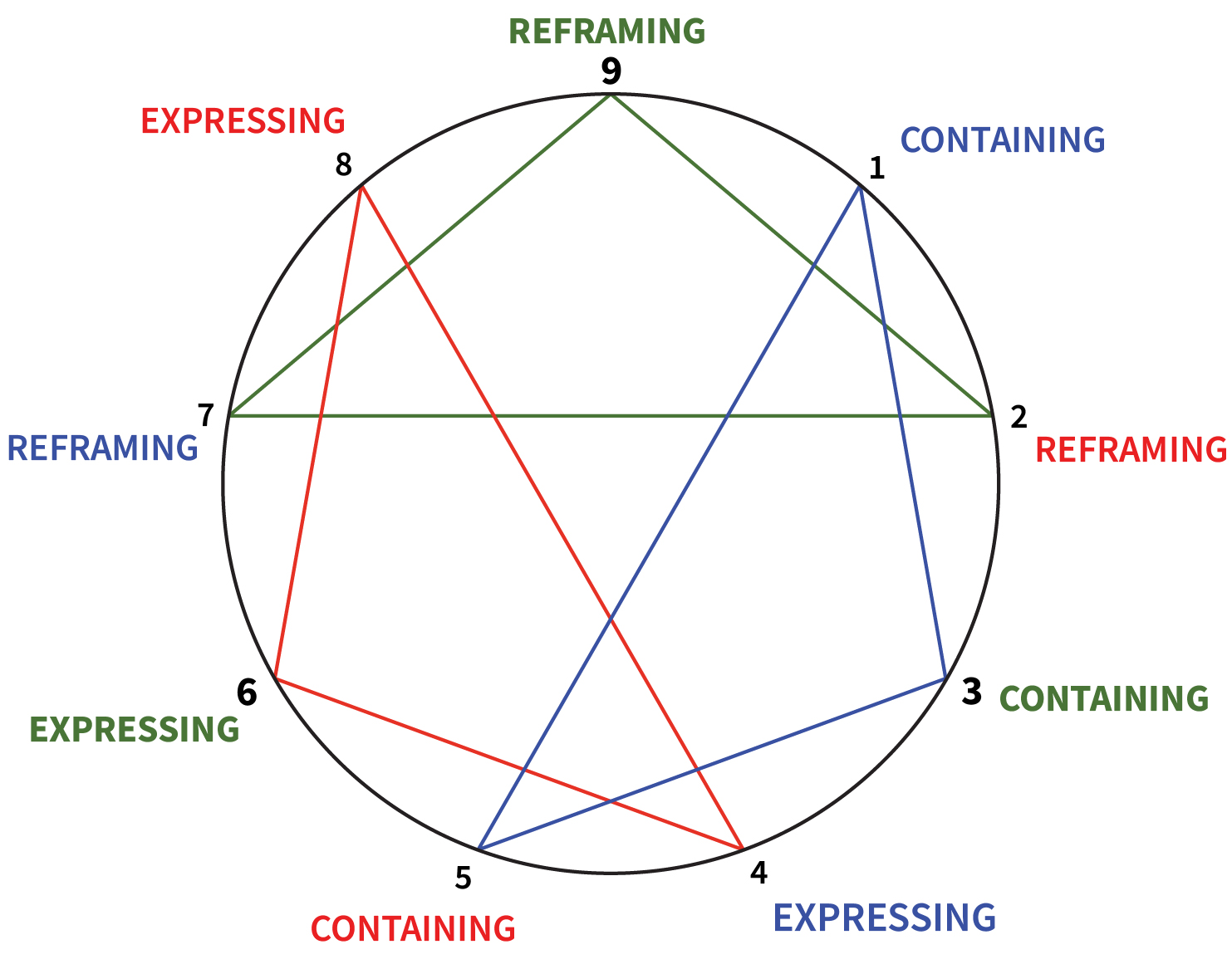
Energy Flow Regulation Triads
(3, 6, 9 connect)
Emotional Regulation Triads
(3, 6, 9 connect)
Study of David Daniels' Work on the Harmony Triads (2010–2012) Reveals the Pathway from 3 Centers to 9 Patterns
A careful study of the Harmony Triads developed by Dr. David Daniels (Figure 3) reveals why three equilateral triangles within the Enneagram circle represent the developmental pathway from 3 motivational Vectors to 9 patterns. This pathway is also consistent with Gurdjieff and Ichazo teachings.
The Harmony Triads contain our fundamental relationship with the world and the nascent, unconscious action we take as young infants and children to restore wholeness between self and the environment, meet our basic needs, and ensure social acceptance and value.
Wholeness in the Harmony Triads shows up in numerous ways, 3 are key to the pathway that forms from the 3 centers/Vectors to the 9 patterns:
- All 3 centers work together to attempt to close the gap between me and “not-me.” Mind in the Enneagram includes all 3 centers operating simultaneously. Although sensations, feelings, and thoughts can originate in one of the centers, all 3 centers rapidly step in to attempt to restore wholeness.
- All 3 centers work together to get the 3 basic needs or motivations met of Agency and Empowerment (Physical Center dominant, ready to receive the environment through the senses and sensations), Bonding and Connection (Emotional Center dominant ready to assert self in response to emotions), and Certainty and Safety (Mental Center dominant, ready to attempt to reconcile self and "environment").
- All 3 centers work in reciprocal harmony between self and the environment. Similar to a biological ecosystem, the first nascent attempts to achieve wholeness in the first year of life, simultaneously serving both the child and the environment. The child begins to resonate with a strategy that will resolve aversive sensations and feelings while also achieving social acceptance and even social reward.
From a biological standpoint, all of the universe is a self-regulating machine. The labelling of the Harmony Triads, by David Daniels, reflects this basic self-regulating process.
When the 3 motivational Vectors are driving or activated, when all 3 centers are working together to attempt to reconcile me and “not-me,” and when the basic biological ecosystem of benefit or value between self and environment are reciprocating, the pathway from 3 centers containing the 3 Vectors is now in motion:
- 3 patterns "ACT FOR" the world
- receive the environment as it is turning outward to act for and help others, avoiding sensations/feelings of rejection and exclusion by the environment
- 2-5-8: Daniels called these the Relationists who move energy in relationships and what they offer others
- receive the environment as it is turning outward to act for and help others, avoiding sensations/feelings of rejection and exclusion by the environment
- 3 patterns "ACT ON" (improve on) the world
- resist the environment turning inward to act/improve on the environment, avoiding sensations/feelings of frustration and uselessness
- 1-4-7: Daniels called these the Idealists who hold an inner vision of the way the world could be
- resist the environment turning inward to act/improve on the environment, avoiding sensations/feelings of frustration and uselessness
- 3 patterns "ACT WITH" the world
- dyadic mediation between turning outward to help others and turning inward to demonstrate internal value, avoiding sensations/feelings of detachment and separation from self and other
- 3-6-9: Daniels called these the Pragmatists who relate to how we blend into, align with, and thrive alongside others
- dyadic mediation between turning outward to help others and turning inward to demonstrate internal value, avoiding sensations/feelings of detachment and separation from self and other
Figure 3: The Harmony Triads – Each Center's Core Point ACTS WITH (Green), Each Side of the Core Center is an ACT FOR (Red) and ACT ON (Blue)
Legend Figure 3:
- RED Triangle: ACT FOR (Outward to Environment)
- BLUE Triangle: ACT ON (Inward to Internal Idealization)
- GREEN Triangle: ACT WITH (Dyadic Outward to Environment and Inward to Internal Idealization)
Importantly, each of these actions or behaviors in the core Harmony Triads also unconsciously regulates internal needs and desires. Acting for others, acting on others, and acting with others means suspending your needs and desires. Thus there is a 3-center harmony regulated response. As you will see in the next section, mind makes the process of regulation possible through monitoring, modification, and modulation:
- Regulation of Attendency-Adaptive Behavior is a monitoring function of mind
- Regulation of Emotion is a modification function of mind
- Regulation of Movement is a modulation function of mind
- David Daniels describes this as: Continuous adjustments to movement as we build our confidence to act (act with confidence in the environment, act with confidence in self, or act with compromised confidence between self and environment)
The Harmony Triads represent the initial movement of the 3 core centers dividing into 3, thus 9 patterns.
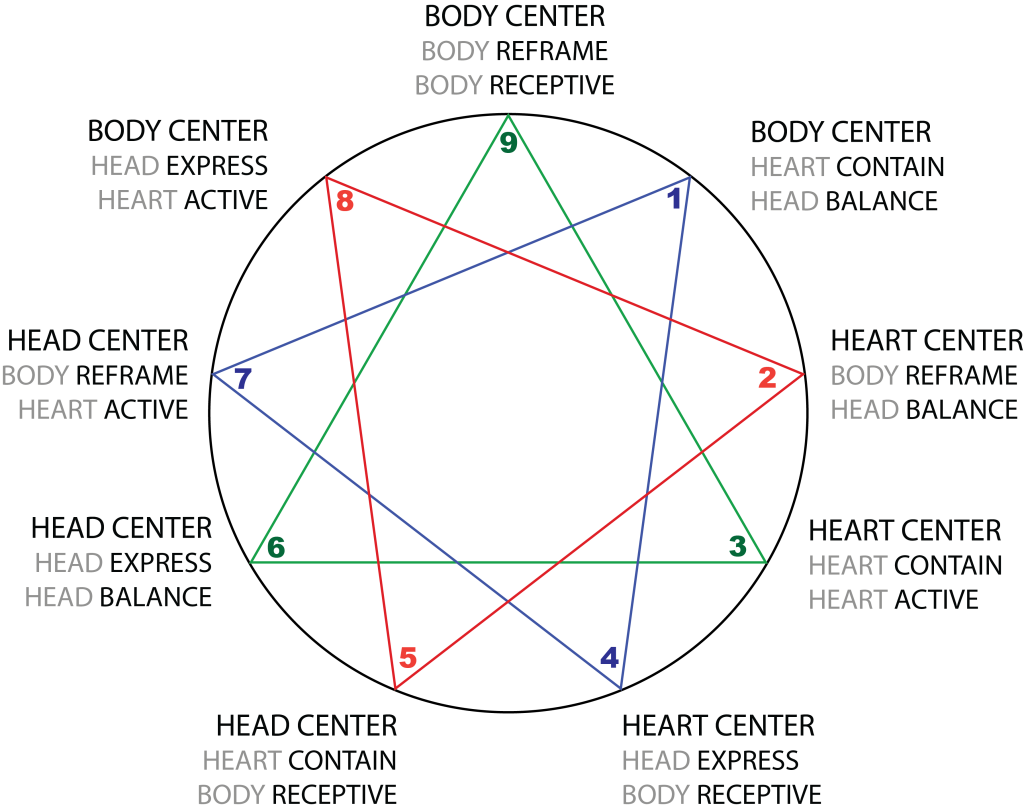
Within the Harmony Triads are 3 additional triads: The Centers, Energy Flow Regulation, and Emotional Regulation, briefly described below.
The Centers Triad:
- The Body Center (9 core) is the seat of our harmony with the world/environment around us. Our natural instinct of Agency and Empowerment requires our Physical Center to receptively sense the surrounding environment (both resources and threats) to survive, driving for harmony and ecological balance of the environment.
- The Physical Center acts on the basis of perceiving what the world/environment needs and individuals have confidence when they understand that need. Their confidence comes from outside.
- The Heart Center (3 core) is the seat of emotion. Emotions, particularly the aversive ones, create the desire for action from inside (the self of the me and "not-me"). Our natural instinct to Bond and Connect requires our emotional center to perceive the "duality" of me and other. It then actively strives to close this gap (to perpetuate the species) by connecting with other. Finding a mate, attracting through "presentation of status," and emotional attunement in bonding are all active behaviors.
- The Emotional Center acts with inner confidence and individuals act based on the inner confidence that what they are "doing" is the right thing at the right time.
- The Head Center (6 core) is the seat of our cause-effect thinking relying on acquiring "data" or knowledge of both self and the world/environment in order to attempt to reconcile them. Our natural instinct for Certainty and Safety requires our mental center to "specialize" in cause and effect thinking to reconcile the gap between the environment and internal state.
- The Intellectual Center acts without confidence and instead individuals act on the basis that other paths of action would be "wrong" (or less "right") – least worst.
- The Body Center (9 core) is the seat of our harmony with the world/environment around us. Our natural instinct of Agency and Empowerment requires our Physical Center to receptively sense the surrounding environment (both resources and threats) to survive, driving for harmony and ecological balance of the environment.
Harmony in the Harmony Triads is further supported by regulation of energy flow and regulation of emotions in which the remote patterns of 1, 2, 4, 5, 7, 8 “link back” to the core centers.
Figure 4: Remote Points Connect to Core Points of 9, 3, and 6.
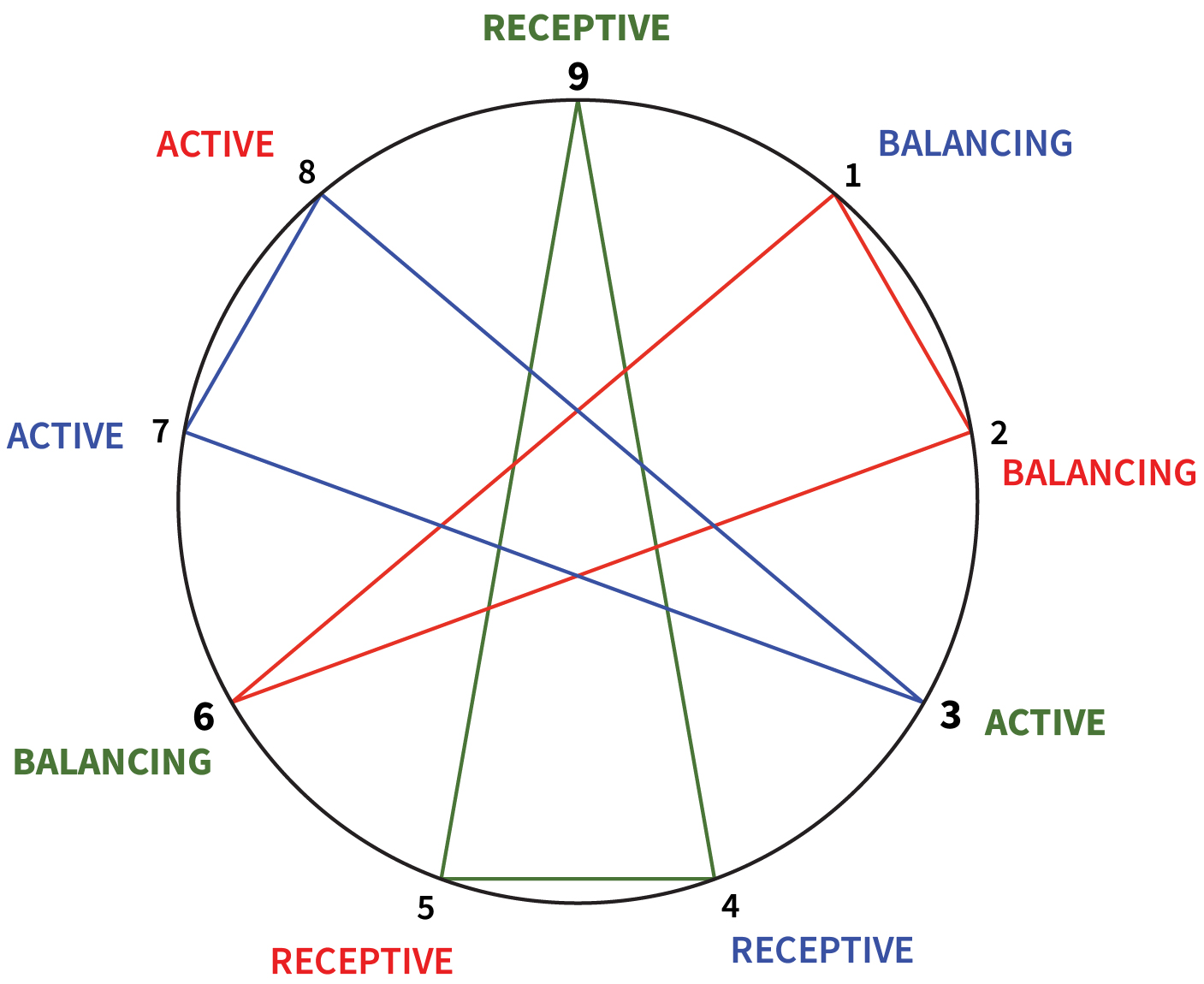
Energy Flow Regulation Triad
- When a gap between needs and desires of self and what others or the environment actually delivers forms, the natural energy flow of the 3 motivational Vectors can contract, restricting energy flow.
- Three types use receptive-physical energy which can also contract to withdrawing behavior (and potential loss of empowerment) (9, 4, 5).
- These patterns place their confidence in understanding the needs of the environment. Their confidence comes from outside. Energy of movement flows inward, but can contract to withdrawing or moving away from others movement.
- Three types use assertive-emotional energy which can also contract to aggressive behavior (and potential loss of connection) (3, 7, 8).
- These patterns place their confidence in inner abilities to know what to do. Energy of movement flows outward, but can contract to aggressive or moving against others energy.
- Three types use balancing-intellectual energy attempting to reconcile internal and external states which can also contract to compliant or dependent behavior (and potential relinquishing internal certainty to other) (6, 1, 2).
- These patterns place their confidence in others or in a compromised confidence. Energy of movement is balancing or moving toward, but can contract to complying to demands of others and the environment.
- This energy flow underlies and is demonstrated in object-relations, describing a young child's movement away from, against, or toward/with other and also arises in numerous other relationships and situations where the “I” and “object on the outside” are not resonating.
- The mind, with all 3 centers working together, has the ability to produce a regulated energy flow response leading the energy of the Vectors along a more natural free flowing path where self and other resonate:
- receptive and present energy
- active and grounded energy
- balanced energy which takes in both self and other
Emotional Regulation Triad
- When a gap between needs and desires of self and what the environment actually delivers forms (in an everyday interpersonal issue, a longer-standing conflict, or traumatic event), aversive emotions arise leading to action to close the gap between me and "not-me."
- Three types have a bias in the Physical Center to restore harmony of the environment. We "reframe" when aversive emotion is combined with our instinct for agency/resistance, repressing our emotions and literally mentally reframing the environment as positive and harmonious (9, 2, 7).
- Three types have a bias in the Emotional Center to take action, to do, and to accomplish. We "contain" when aversive emotion is combined with our instinct for bonding, suppressing our emotions to maintain connection with others while taking time to mentally reason and build rationale and logic to solve problems (3, 1, 5).
- Three types have a bias in the Intellectual Center to reconcile the gap between me and “not-me” with intellectual knowledge. We "express" when aversive emotion is combined with our instinct to master the environment and achieve successful resolution, amplifying our emotions to uncover “data” and knowledge about the root cause of problems and mentally apply it to propose solutions (6, 4, 8).
- A spectrum of emotionally regulated behaviors are demonstrated in everyday interpersonal ruptures, more serious events requiring conflict resolution, and in trauma where the gap between “I” and what the environment delivers is very wide.
- The mind, with all 3 centers working together, has the ability, with our conscious awareness, to produce a regulated emotional reaction leading to:
- shifting emotions without completely repressing them
- down regulating emotions so they are contained and present rather than suppressed
- up regulating emotions enough for constructive expression and verbalization to uncover "what's really going on" and increase knowledge
- When a gap between needs and desires of self and what the environment actually delivers forms (in an everyday interpersonal issue, a longer-standing conflict, or traumatic event), aversive emotions arise leading to action to close the gap between me and "not-me."
Brief Description of the Limitation in the 2024 PDP Attendency Hypothesis
The limitation in the PDP Framework Attendency hypothesis (2024) resulted from failing to include key information.
The Enneagram System as a Sum of All Parts.
We did not examine all parts of the Enneagram system which would have revealed a more complete hypothesis and a complete three-fold symmetrical structure.
- Inclusion of the Harmony Triads developed by David Daniels was not fully understood until after he died (and after we published the PDP Attendency hypothesis). This would have brought a more complete picture to our PDP Framework in how we get from 3 Centers to 9 Patterns.
- Inclusion of the 3 Instincts would have helped us discern the relationship between the 3 centers and the 3 motivational Vectors, including study of the original Gurdjieff and Ichazo sources.
The Enneagram Mathematical Structure Informs Biology
We did not go deep enough to acknowledge the mathematical structure and objectivity embedded in the Enneagram symbol. The Enneagram is an Eastern science which is deductive. It starts with the whole and deduces the parts. In contrast, Western science is a “cumulative” work. Eastern science operates as a simple mathematical abstraction that is capable of predicting complex instances. What is vital to understand is that the Enneagram was brought to the West in the 20th C. as it reveals the mathematical structure and natural physical laws of consciousness, both how and why the content of consciousness is 3-fold-unfolding organized and the diatonic-octave process of how consciousness evolves. Scientists studying consciousness today have proved that it must be mathematically structured, but the mathematical structure eludes them. The Enneagram reveals that structure.
The Enneagram System is a Sum of All Parts Working Together
The Enneagram System includes 3 Centers of Intelligence:
- the Physical Center
- the Emotional Center
- the Intellectual Center
These three centers work together and represent "mind." Each center of intelligence evolved to serve the 3 instincts and includes key functions of input (attention), processing (the interaction of the memory of DNA and of the memory of learning), and output (intent-action).
The system also produces biological reciprocity between self and the environment. The 3 instincts are stored in DNA and all 3 are in all 3 centers, but one comes to dominate. We will start with the instincts.
Incomplete Understanding of the Instincts
- Stored in DNA are the 3 natural instincts before they are distorted from conditioned learning.
- In the Enneagram of Personality we know the instincts of self-preservation, sexual, and social, based on Naranjo's articulation and application of the Enneagram to understanding characterological disorders and psychopathology.
- In the global Gurdjieff scholarship and the original teachings of Ichazo, we know that we start out with 3 natural or "pure" instincts that support all of life. All three instincts are found in all 3 centers. A careful reflection on these instincts indicates that Agency, Bonding, and Certainty represent the three natural instincts before conditioned learning limits them.
- The instinct for our species to survive and thrive (dominant in the Body Center) --> contracts/distorts to Self-Preservation.
- The instinct to connect with our species (dominant in the Heart Center) --> contracts/distorts to 1:1 Select Few.
- The instinct to "master the environment" of which social adaptation is a part (dominant in the Head Center) --> contracts/distorts to Social Cover Up for Not Contributing.
- Stored in DNA are the 3 natural instincts before they are distorted from conditioned learning.
This discrimination between the natural and distorted instincts was discovered when researching the knowledge embedded in the Harmony Triads, and sourcing the objective knowledge of Gurdjieff and Ichazo. It would have helped the PDP Group discern that the 3 Vectors actually describe the 3 Natural Instincts before they are conditioned by personality, and that the Vectors are functions within the 3 Centers of Intelligence.
Incomplete Understanding of the Harmony Triads
- As a representation of a biological ecosystem, harmony is demonstrated in three triads within the Harmony Triad, in turn, all three Centers of Intelligence are represented, simultaneously bringing benefit to self and to others. We use our personality to achieve our needs, but at the same time as our personality develops, we discover we can bring value to others and the environment.
- The Centers Triad – each of the centers contains all three instincts in the memory of DNA with considerable cross over of each of the 9 patterns using strategies of all 3 Vectors (but dominance as noted above)
- The Energy Flow Regulation Triad
- The Emotional Regulation Triad
- As a representation of a biological ecosystem, harmony is demonstrated in three triads within the Harmony Triad, in turn, all three Centers of Intelligence are represented, simultaneously bringing benefit to self and to others. We use our personality to achieve our needs, but at the same time as our personality develops, we discover we can bring value to others and the environment.
Each of the 3 Centers of Intelligence are centers of function, with primary oversight of the functions of: (1) Attention (Consciousness), (2) Memory (Stored in DNA and new associations of meaning and significance), and (3) Action (Behavior directed from Aim/Intent to close the gap between self and an environment that does not always match our "internal world").
Figure 5 highlights the functions of each center which roughly correspond to input, internal processing, and output. The 3 instincts/needs of Agency, Bonding, and Certainty have dominance in the Physical, Emotional, and Intellectual center respectively, considered not learned as they are in the memory of DNA and do not require learning.
In addition, the functions of each center may look like "conscious strivings," but they are not. They are happening unconsciously or mechanically between input-processing-output as a child is attempting to close the gap between self/internal state and environment/external information.
Figure 5: Summary of Key Functions of the Centers of Intelligence of which the 3 Instincts/Motivations are a Function of the Memory of DNA
All centers are operating mechanically or unconsciously through the memory of DNA, through automatic instincts that do not require learning, and through new conditioned associations of meaning and significance between self and environment, stored and used mechanically.
THE BODY CENTER – Our Physical Center receives the environment through senses and movement
- Sensorimotor (sensing and moving) attention or consciousness
- E.g., Noticing through sight and touch how water pools in a hollow rock
- Memory of DNA, including the instincts AND memory of new associations formed through sensorimotor associations (hot-move away, loud noise-startled, "in my space"-resist)
- All 3 instincts, The natural instinct for the species to survive and thrive, Agency & Empowerment is dominant
- The instinct distorted by conditioned personality is SELF-PRESERVATION
- Mind with auto-pilot aim or intent and action, working with the other 2 centers
- Sensorimotor (sensing and moving) attention or consciousness
THE HEART CENTER – Our Emotional Center asserts self through emotion
- Emotional (feelings and intuition) attention or consciousness
- E.g., Intuiting drinking safely from a hollow rock instead of visiting the dangerous river or spring
- Memory of DNA, including the instincts, AND memory of new associations formed through intuition (shadow approaching-danger, watching sunsets-joy)
- All 3 instincts, The natural instinct to connect with our species, Bonding & Connection are dominant
- The instinct distorted by conditioned personality is SEXUAL
- Mind with auto-pilot aim or intent and action, working with the other 2 centers
- Emotional (feelings and intuition) attention or consciousness
THE HEAD CENTER – Our Intellectual Center attempts to reconcile the environment and internal feelings
- Intellectual (cause and effect thinking) attention or consciousness
- E.g., formulating a plan for making "better" hollow rocks that can hold more water
- Memory of DNA, including the instincts, AND memory of new associations formed through cause-effect thinking
- All 3 instincts, the natural instinct to master our ecological and social environment, Certainty & Safety is dominant (rural living leads to healthier lifestyle, being second born leads to higher creativity)
- The instinct distorted by conditioned personality is SOCIAL
- Mind with auto-pilot aim or intent and action, working with the other 2 centers
- Intellectual (cause and effect thinking) attention or consciousness
In addition, the functions of each center may look like "conscious strivings," but they are not. They are happening unconsciously or mechanically between input-processing-output as a child is attempting to close the gap between self/internal state and environment/external information.
From here, we now have the building blocks to "rebuild" a Patterns of Developmental Pathways Framework based on the Harmony Triads.
Patterns of Developmental Pathways Framework Based on David Daniels' Enneagram Harmony Triads Work
The Harmony Triads and Biological Ecosystem
In an evolution of reciprocal systems in which manifest life serves the universe and the universe serves us, basic harmony is established. As a young, all-dependent infant we receive from the universe the meeting of many or some of our needs to survive as well as opportunities to thrive. In turn, as we develop and grow, we discover that our inborn capacities have potential to provide value to our environment and the social world we live in.
We use all three centers to take in information and process it, forming sensorimotor, emotional, or cause-effect associations between the environment and our internal state. We store successful attempts to close the gap between self and with the environment, as well as unsuccessful attempts. Memory of our conditioned associations has a build up in the center that "works” – acting as a center of “gravity” or reliance to close the gap between me and "not-me."
The Harmony Triads reveal the first and most fundamental relationship between me and “not-me” or self and the world. Once a young child experiences aversive emotions as a result of our inner state and outer environment forming a gap, an attempt to reconcile and take action is made. Within each center (see Figure 6) is a triad of the personality acting for the world (outward), acting on the world or improving on the world (inward), and acting with the world (dyadic).
"ACT FOR" the world is what Ichazo called "action" which takes the world "as it is” but also holds it to be "true."
Whereas "ACT ON" the world is what Ichazo called "reaction," which asserts that there is a "better" truth than what "is” right now.
Sitting in the middle is "ACT WITH" the "point of balance" between asserting and improving.
- ACTING FOR the world –
- “I receive the world as it is and I go out to help others use it as it is.”
- ACTING ON the world –
- “I resist the world as it is and I go inside to create a new and better way to view the world to lay on top of today's world.”
- ACTING WITH the world –
- “I balance or mediate between acting for the world (helping others) and acting on the world (bringing my inner value to others).
- ACTING FOR the world –
Figure 6: Centers, Direction of Action, and Value to Others
In the BODY CENTER, primarily driven by the Instinct to Survive and Thrive
- We can ACT FOR the universe — Protect others from harm while shielding myself from vulnerability (Type 8)
- We can ACT ON the universe — Make myself perfect and share my idealized harmony with others simultaneously achieving my own internal goodness (Type 1)
- We can ACT WITH the universe — Minimize self and blend with others to prevent conflict and preserve a peaceful environment and harmony for myself (Type 9)
In the HEART CENTER primarily driven by the Instinct to Connect With Our Species
- We can ACT FOR the universe — Meet needs or make connections for others while also gaining approval for helping others (Type 2)
- We can ACT ON the universe — Make myself the one who connects our shared existential concerns and desires and share them with others simultaneously gaining a deep sense of connection for self (Type 4)
- We can ACT WITH the universe — Identify with doing and the internal value I bring and stay connected to make sure others approve of what I do (Type 3)
In the HEAD CENTER, primarily driven by the Instinct to Master Our Environment
- We can ACT FOR the universe — Help others to solve their problems while creating models of understanding the world for my own knowledge (Type 5)
- We can ACT ON the universe — Make myself the one with a future ideal of wisdom and share it with others while simultaneously providing myself with positive options for the future (Type 7)
- We can ACT WITH the universe — Question the nature of reality for self and others while reducing doubt and building predictability (Type 6)
Each of the three Harmony Triads is supported by the regulating capacity of the mind (all 3 centers working together) to manage one's internal desires and needs.
- 3 types move outward to meet and influence the world (8, 2, 5) achieving value by "ACTING FOR" others.
- To ACT FOR the world, you need to suspend your own desires in order to meet what others need.
- 3 types move inward to anticipate the world (1, 4, 7) achieving value by demonstrating their idealization thus "ACTING ON" others.
- To ACT ON the world, your own desires are usurped by the pursuit of an ideal.
- 3 types participate by "ACTING WITH" others in the world in a dyadic movement of inward and outward (3, 6, 9) achieving value by mediating between demonstrating inner value on others and acting for others.
- To ACT WITH the world, you need to be able to balance multiple desires.
- 3 types move outward to meet and influence the world (8, 2, 5) achieving value by "ACTING FOR" others.
An Enneagram Comprehensive Patterns of Developmental Pathways Framework
Figures 7, 8a, and 8b present an updated PDP model of wholeness which incorporates the whole Ennegram System. We begin in the womb with an experience of unity.
Our birth and sensate experience of separation leads to our attempts to restore wholeness. One of our primary Centers of Intelligence becomes dominant in closing the gap between "self” and "environment." Although all 3 instincts are in all 3 centers, one becomes dominant:
- The Instinct to Survive and Thrive is the motivational Vector of Agency and Empowerment, served by the Physical Center
- The Instinct to Connect With Our Species is the motivation Vector of Bonding and Connection, served by the Emotional Center
- The Instinct to Master Our Ecological and Social Environment and Make it More Amenable is the motivational Vector of Certainty and Predictability, served by the Intellectual Center
Second, each of the Centers of Intelligence has a dominant issue:
- Physical Issue: The Sensorimotor Center with heightened sensitivity to sensing and moving leans into an outward focus on the senses soaking up impressions. Outer focus out-weighs inner focus.
- Emotional Issue: The Emotional Center fueled by feelings become the seat of initiating and doing, action to "move-in" on others and action to create an attracting image to bring others in are key in forming connections.
- Mental Issue: The Intellectual Center is the seat of attempting to reconcile the gap between inner state and external environment, over-thinking and tentative action is a result of attempting or failing to reconcile the states.
Third, a fundamental biological reciprocity of relationship of self to environment/world is initiated as:
ACT FOR
ACT ON (Improve On)
ACT WITH
From here there are two fundamental strategies for regulating energy flow and regulating emotions which both work to satisfy all three motivational Vectors.
Finally, as a conditioned personality develops, the pure or natural instincts become distorted and are labelled as Self-Preservation (me over other members of my species), Sexual (exclusive care and focus on only some members of my species), and Social (one part of the instinct to master the environment revealing a distorted social instinct which is a cover up for not contributing to the group). One of the instincts or motivational Vectors, not necessarily the one in your dominant center, loses its natural operation, resulting in 27 patterns (distorted by learned conditioning).
Figure 7: An Enneagram Comprehensive Patterns of Developmental Pathways Framework
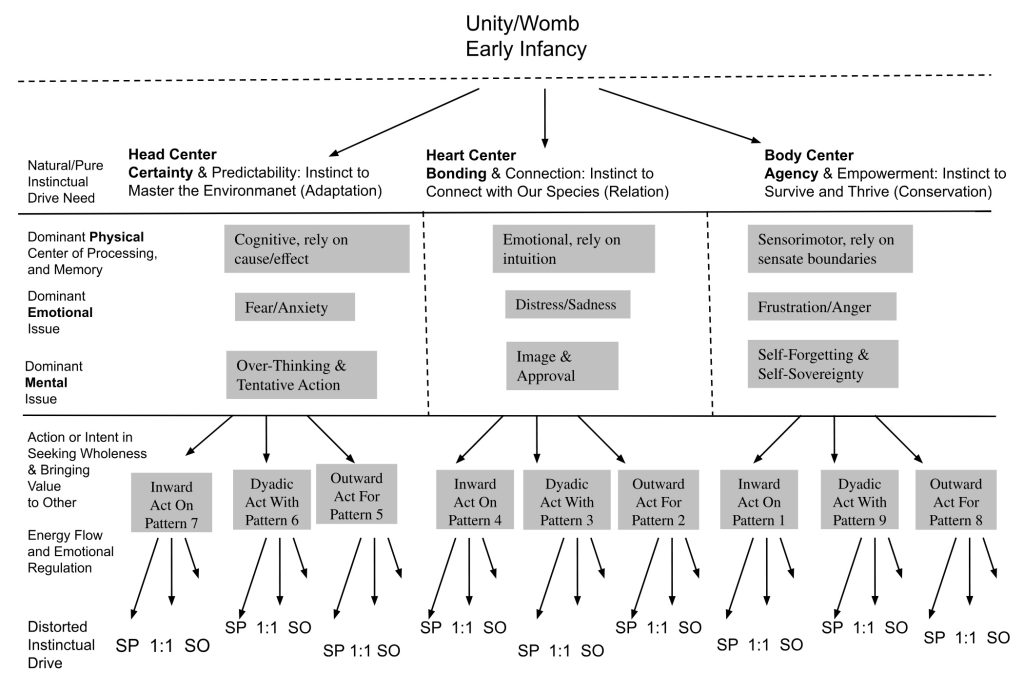
Figure 8a: Summary of an Ennegram Comprehensive PDP Framework: Vectors, Attendency-Action, Energy Flow Regulation, Emotional Regulation
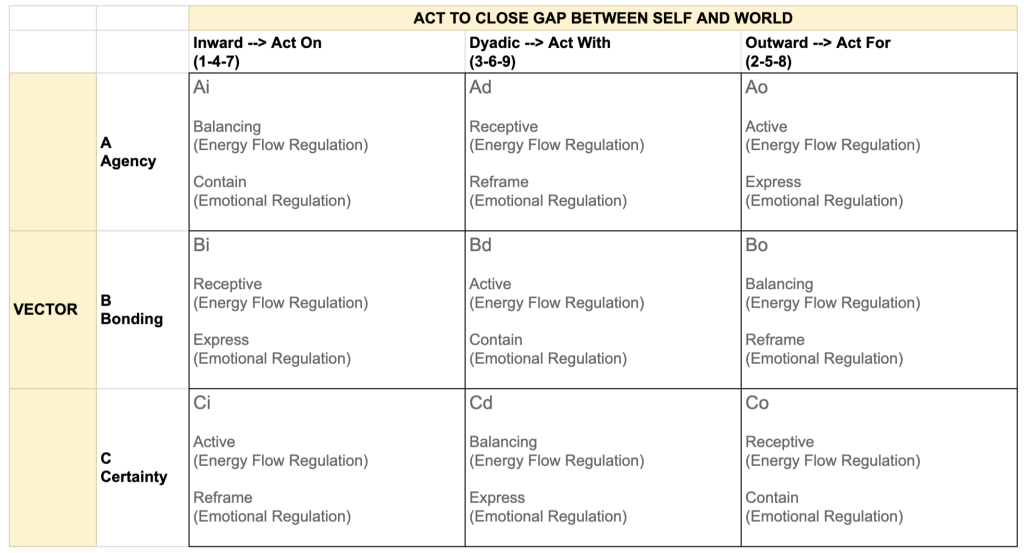
Figure 8b: Detail of an Ennegram Comprehensive PDP Framework: Vectors, Attendency-Action, Energy Flow Regulation, Emotional Regulation
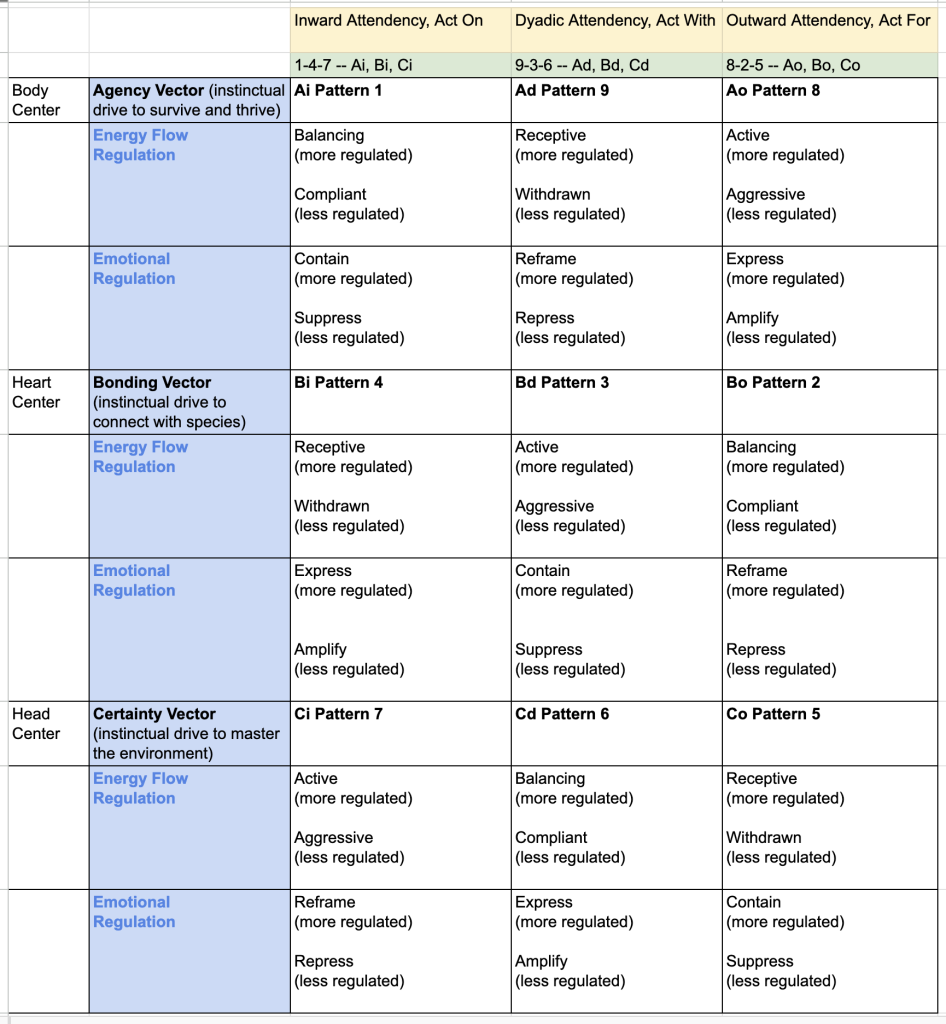
Author Notes
Background to this Article by Denise DanielsThis article is based on the work of David Daniels to understand the nature of the nine Enneagram types based on the Enneagon first described by Ichazo. In December of 2024, Norton released a book on the 9 Patterns of Developmental Pathways (PDP) Framework. Dan Siegel and the PDP Group emphasized throughout the book that the framework was a working hypothesis. A year later, December 2025, I discovered that one of our hypotheses, Attendency as a pathway mechanism from 3 to 9 patterns, does not hold up for Pattern 5 and 7. Other parts of the PDP hypothesis can be validated by Enneagram objective science which is a mathematical abstraction of the structure of human consciousness. I have always been interested in how the 9 Enneagram patterns came to be. We can all see they exist. No one can dispute, for example, that there are really 8 or that one pattern was missed and there are 10 patterns. But why and how did these 9 naturally occurring patterns come to be? Before addressing that, I cannot stress enough that this question is far less important than doing "the work" to become conscious. All the intellectualizing in the world will not replace the importance of bringing the Inner Witness, Controlled Attention, Presence, and Responsiveness to our daily lives. Our last PDP group meeting with all five members of the PDP group present was held in 2010. David started developing his Harmony Triads work around 2008, and published it in 2010. The PDP book was written in 2023-24. In 2025, I took a sabbatical year to study the objective science and mathematics of the Enneagram and piece together David's understanding and writings about the Enneagram Harmony Triads. David's work on the Harmony Triads along with the Enneagram Diagram, became the focus of my study in 2025. The results of this study are presented in this article. CONTRIBUTORS TO THE UNDERSTANDING OF THE HARMONY TRIADS It is important to note, that although David Daniels can be credited with linking all triads and the 3 centers in the microcosm of The Harmony Triads, the parts that make up the whole of the harmony include work of Ichazo, A.H. Almaas, Jesuit and philosopher, Tad Dunne, Ph.D. (1971-73), psychologist, Bill Schaefer Ph.D. (2009), and Gurdjieff scholar, Steven Wheeler (2020-26). With Naranjo’s early quest to seek Why 9?, Jesuit Bob Oches (1970-71) encouraged colleague Tad Dunne who observed that some infants experience themselves as larger than the world and can exercise control (2-5-8), and other infants experience themselves as smaller than the world and mainly react to controls on self (4-7-1), and other infants who fit in to whatever is going on (3-6-9). This results in some of us who bring the universe into the self (2-5-8) and others who mainly project self into the world (4-7-1), and others that balance between these only two possibilities (Steven Wheeler Gurdjieff scholarship). During 1971-74, Tad Dunne taught two of the triads, including this fundamental relationship to the world and a child’s object relations to Beesing, Nogosek, O’Leary, Hurley, Dobson, and Riso. Psychologist Bill Schaefer further identified that “below” early object-relations movement was an even more fundamental movement of life force energy. All three centers and instincts are supported by the strategies of the Harmony Triads. Finally, the earliest identification of the conflict resolution triad can be found with Riso and Hudson. That we use an emotional regulation strategy to resolve challenges, conflicts and trauma was further articulated by Jack Killen. The information here, along with another article titled, The Objective Enneagram of Personality, will allow you to replicate the findings on Attendency for Patterns 5 and 7. Additional hypotheses in the PDP Framework do suggest consilience with the objective patterns of the Enneagram. And, it is particularly interesting to note that the 3 Vectors of Agency, Bonding, and Certainty represent the natural/pure instincts (identified in both Gurdjieff and Ichazo scholarship) before they become limited by conditioned learning. Most importantly, this article will better serve the clinical and practical work of therapy with Type 5 and 7 clients. Type 5 with over-bias in observing the world, can also focus on their internal states and asserting their needs. Type 7, who is often "self-referencing" can balance and heal by noticing the needs of others and the environment. In addition, researchers will have an objective mathematical basis linked to the developmental pathways for Types 5 and 7, as well as the other patterns in the original PDP 2024 publication which are clearly verified in the Harmony Triads. Please write to Denise Daniels about any questions or to set up a discussion: denise@drdaviddaniels.com AppendicesEnneagram Attention Bias Across Centers, Types, and Sub-types
|